Spider mites are tiny relatives of spiders that suck the sap from the underside of rose leaves, leaving them dull, pale and finely speckled, sometimes with fine webbing. They thrive in hot, dry, dusty, still weather and on thirsty roses. Hose the undersides, water deeply, keep the bush open, and use organic sprays only when the numbers keep climbing.
Spider mites always tell me the same thing: something got too hot, too dry and too still. They are less a pest than a weather report.
When I fix the conditions, with a good hard hosing, steady water at the roots and air moving through the bush, they mostly leave on their own. I never blanket spray for them. That only kills the predatory mites that keep them in check, and two weeks later you have a real plague.
How to tell it's spider mites
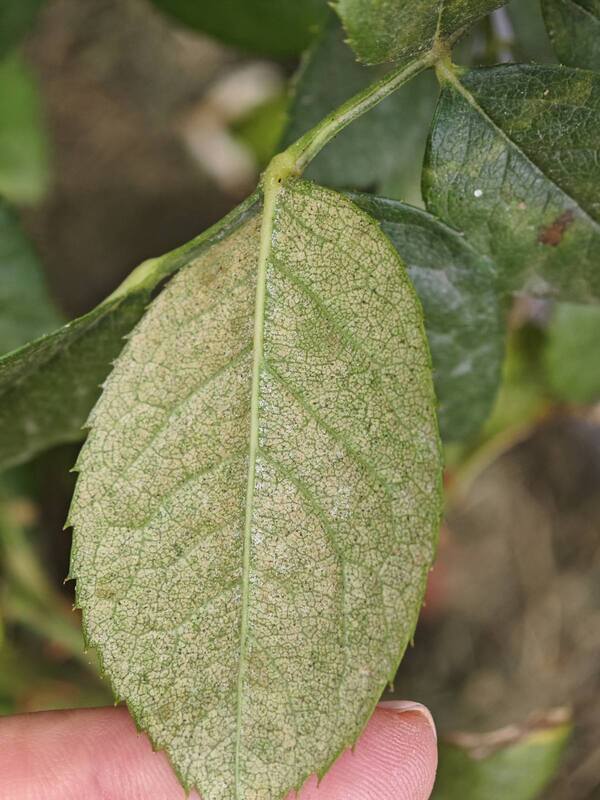
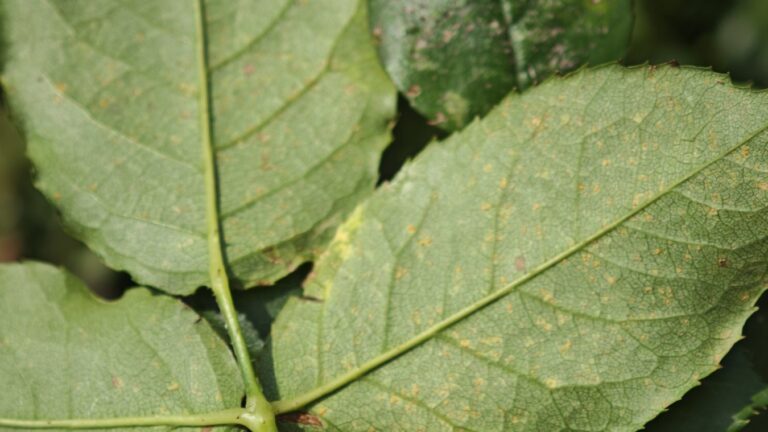
Look at the leaf from a little distance first. A rose with mites looks tired in a way that’s hard to name: dull, pale, a little bronzed, as if someone had lightly sandblasted the leaves. Up close you’ll see thousands of tiny pale dots, each one a spot where a mite drained a cell.
Then turn the leaf over. The damage is worst underneath, and in a bad spell there’s fine webbing at the shoot tips and in the angles where leaves meet the stem. The mites themselves are about the size of a period on this page. Tap a leaf over a sheet of white paper. If the specks start to crawl, you have your answer.
Two things get mistaken for mites. A hungry rose can yellow evenly, but hunger leaves no speckling and no web. Downy mildew makes purple patches with a grey film underneath, and it comes in cool, wet weather, the exact opposite of mite weather.
What brings them
Heat, first of all. The twospotted spider mite, the one most gardeners meet on roses, takes about 28 days to go from egg to adult at 60°F (16°C). At 82°F (28°C) it needs about 8 days, and above 90°F (32°C) it can manage in as few as 5. That’s why a quiet colony on a few lower leaves can take over a bush during one heat wave.
Dust and drought do the rest. Mites love roses baking against a hot wall, roses next to a dusty path, and roses left to go dry between waterings. A crowded bush helps them too: dense foliage traps heat, the leaves inside run hotter and drier, and that’s exactly the climate mites want.
The science, in plain words
University pest specialists in California note that spider mite outbreaks often follow insecticide sprays. Broad-spectrum insecticides, such as carbaryl and some pyrethroids, kill predatory mites, lacewings, and tiny beetles that eat spider mites. The spider mites breed back faster than their enemies, and the next generation has the bush to itself.
Companion plants: a home for the mite hunters
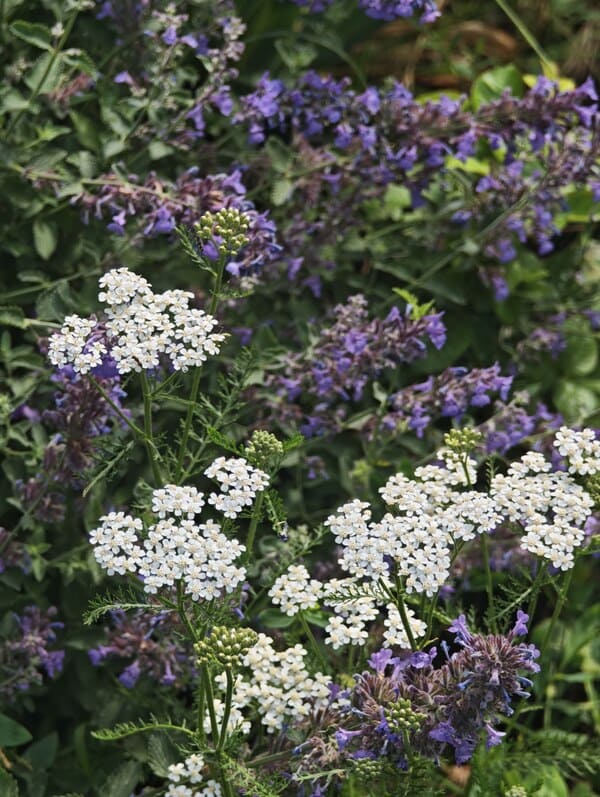
This is the part of my mite control that costs nothing and works all season. Yarrow, sweet alyssum and the other small flowering companions I grow around my roses bring in the creatures that eat spider mites: ladybugs, lacewings, predatory mites and the other small hunters.
Flowering plants give these predators what a bare rose bed can’t: nectar and pollen to live on between meals, and shelter close to the roses. So when mites do arrive, the hunters are already in the neighborhood. University pest specialists point to these same predators as the main reason spider mites usually stay low outdoors, as long as nobody sprays them away.
What I do when I find them
- Hose the undersides, hard. A strong jet of water aimed up under the leaves knocks the mites and their webs off and raises the humidity they can’t stand. I do it early in the morning so the leaves dry long before evening, and I repeat it every few days while the hot spell lasts.
- Water deeply and mulch. A thirsty rose suffers far more from mites. Deep watering at the roots and a good layer of mulch to hold the moisture are part of the treatment, not an extra.
- Start with the gentle sprays. For a light infestation I use whey, diluted one part whey to five parts water, sprayed on both sides of the leaves in the evening every four to five days. A strained garlic infusion works the same way and also helps against fungi. These are support, not a cure: they slow the mites down while the water and the predators do the heavy work.
- If the numbers keep climbing, neem oil or avermectin. Neem oil works only where it touches, so wet the undersides properly and repeat. I always apply it on its own, on a day of its own, never mixed with anything. My other tool is a biological product based on avermectins (aversectin C), natural compounds made by a soil bacterium called Streptomyces. It works on both sucking and chewing pests. In the US, look for the active ingredient abamectin. Spray it in the evening, when the bees have finished for the day.
- For a strong outbreak, sulfur. Sulfur works well when mites have really taken hold, but it comes with rules. Only below 82°F (28°C), because it burns leaves in the heat, which can be tricky in mite weather, so pick a cooler morning or evening. And keep sulfur and oil sprays well apart: the University of California advises at least 30 days between sulfur and an oil spray such as neem. Sulfur also hits the predatory mites, so I keep it for the moment when nothing else is holding. Most of the time it never comes to that: water and patience beat a bottle here.
Ann’s note
I haven’t seen a spider mite problem in my own garden for a couple of years now. I think the reason is the whole system together rather than any single spray: Beauveria once or twice a month for prevention, companion plants all around the roses, open, well-kept bushes, and a garden that has settled into its own balance, where mites find it very hard to survive.
Prevention: keep the bush cool, moist and lively
The best defence against spider mites is a garden they don’t feel at home in. From the time the days stay above about 61°F (16°C), my roses get a spray of Beauveria bassiana, a fungus that infects insects and mites, once or twice a month on the leaves, in the evening, because sunlight kills its spores within hours. In my garden, Beauveria works beautifully.
The rest is plain gardening. Prune for an open, vase-shaped bush, so air moves through and the leaves stay cooler. Don’t plant roses too close together. In a heat wave, rinse the leaves now and then to keep the dust down. And keep the garden friendly to predatory mites and lacewings, which means no broad insecticides, ever.
A few rules for mixing
Beauveria and avermectin go on separately, five to seven days apart, never in one tank. I consider that pairing one of the most effective things I use against spider mites, aphids and thrips, as long as each gets its own day. Neem oil always goes on alone. After sulfur, I wait 10 to 14 days before anything live, Beauveria included, goes back on the leaves, because sulfur is hard on the good organisms too.
These mites are one of more than 35 problems I walk through photo by photo in What’s Wrong With My Rose?, each with what to do now and how to stop it from coming back.
Questions gardeners ask
Are spider mites insects?
No. They are tiny relatives of spiders and ticks. That's one reason most insecticides do so little against them.
Why did my roses get worse after I sprayed an insecticide?
Broad chemical insecticides kill the predators that keep spider mites down. The mites recover faster than their enemies, so an outbreak often follows the spray.
Do I need a chemical miticide?
I don't use one. Water, a cool open bush, Beauveria on schedule and, when needed, neem, avermectin or sulfur keep spider mites small in my garden.
Which companion plants help against spider mites?
Small flowering companions such as yarrow and sweet alyssum. They feed and shelter ladybugs, lacewings and predatory mites, which hunt spider mites.
Can neem oil or sulfur burn my roses?
Yes, in heat or strong sun. Spray in the cool of morning or evening, never on a thirsty rose, and keep sulfur and oil sprays at least 30 days apart.
Sources
- Spider Mites, Pest Notes. UC Statewide IPM Program, University of California. https://ipm.ucanr.edu/home-and-landscape/spider-mites/
- Twospotted Spider Mite, Floriculture and Ornamental Nurseries Pest Management Guidelines. UC IPM. https://ipm.ucanr.edu/agriculture/floriculture-and-ornamental-nurseries/twospotted-spider-mite/
- Two Spotted Spider Mite, fact sheet. University of Delaware Cooperative Extension. https://www.udel.edu/content/dam/udelImages/canr/pdfs/extension/factsheets/Two-Spotted-Spider-Mite1.pdf
- Horticultural Oils. UConn Home and Garden Education Center. https://homegarden.cahnr.uconn.edu/factsheets/horticultural-oils
If you want to go further
Healthy roses start long before the first spot

What's Wrong With My Rose?
A photo by photo field guide to more than 35 rose problems, each one solved organically.

Revolution in the Rose Garden
How I build living soil and keep disease away, without chemicals.

Rose Garden Planner 2027-2028
Two seasons of schedules, treatments and notes in one book.