Rose Home Garden

by Ann Devis

Garden ideas · Planting plans

Ready to copy:Rose garden planting plans

Five rose beds drawn from above, with every plant named and spaced. Take them to the garden center, change what doesn't suit your garden, and make them yours.

Before you start

Painting with plants

I think a gardener is an artist who paints with plants, and nature keeps adding brushstrokes you never planned. So treat these plans as a starting point, not a blueprint. Take the colours you love, swap any plant that doesn't suit your zone or your light, and keep watching what happens when two plants meet.

Almost every bed I love works in one of three ways. One colour in many shades looks calm and makes a small garden feel bigger. A bold contrast, like violet next to soft yellow, makes both colours glow, as long as you use it in small doses. And texture and surprise: spiky leaves beside round ones, a tall iris rising out of a low carpet.

How to read the plans

  • Back of the bed at the top, the path at the bottom.
  • The letters match the plant list.
  • Each circle shows the plant at its grown size. Plant in the center of the circle and leave the space around it, however empty it looks at first.
  • For two different plants side by side, add their mature widths and halve the sum.
  • Fill the gaps the first year with annuals such as sweet alyssum or cosmos, or with mulch.

Check your zone and light before you buy, prepare the soil with compost first, and mulch everything after planting.

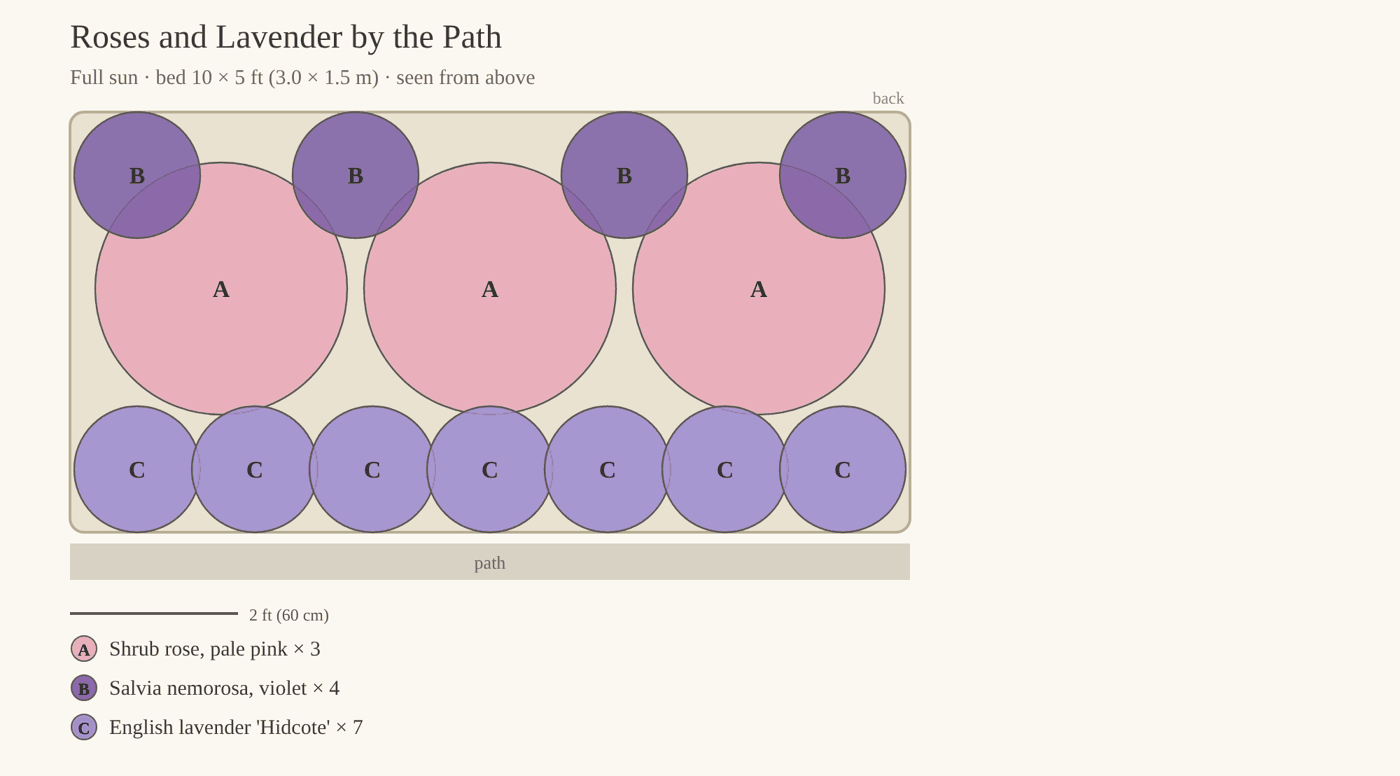
Planting plan: Roses and lavender by the path, seen from above

Plan 1 of 5

Roses and lavender by the path

Full sun · bed 10 × 5 ft (3 × 1.5 m) · the idea: shades of pink and violet

This is the way I plant roses and lavender in my own garden. The lavender sits at the front edge of the bed, the roses a little further back, and behind them the dark spikes of salvia give depth. The drip line runs under the roses, and the lavender gets almost no extra water.

You'll need

  • A Shrub roses in pale pink, 3 plants, about 3 ft (90 cm) apart. Choose a disease-resistant variety for your zone.
  • B Salvia nemorosa in violet, such as 'Caradonna', 4 plants behind and between the roses.
  • C English lavender 'Hidcote', 7 plants about 18 in (45 cm) apart along the path.

When it's beautiful: From early summer, when roses and lavender flower together, and again with the roses' second flush. Cut the salvia back after its first flowering and it will flower again.
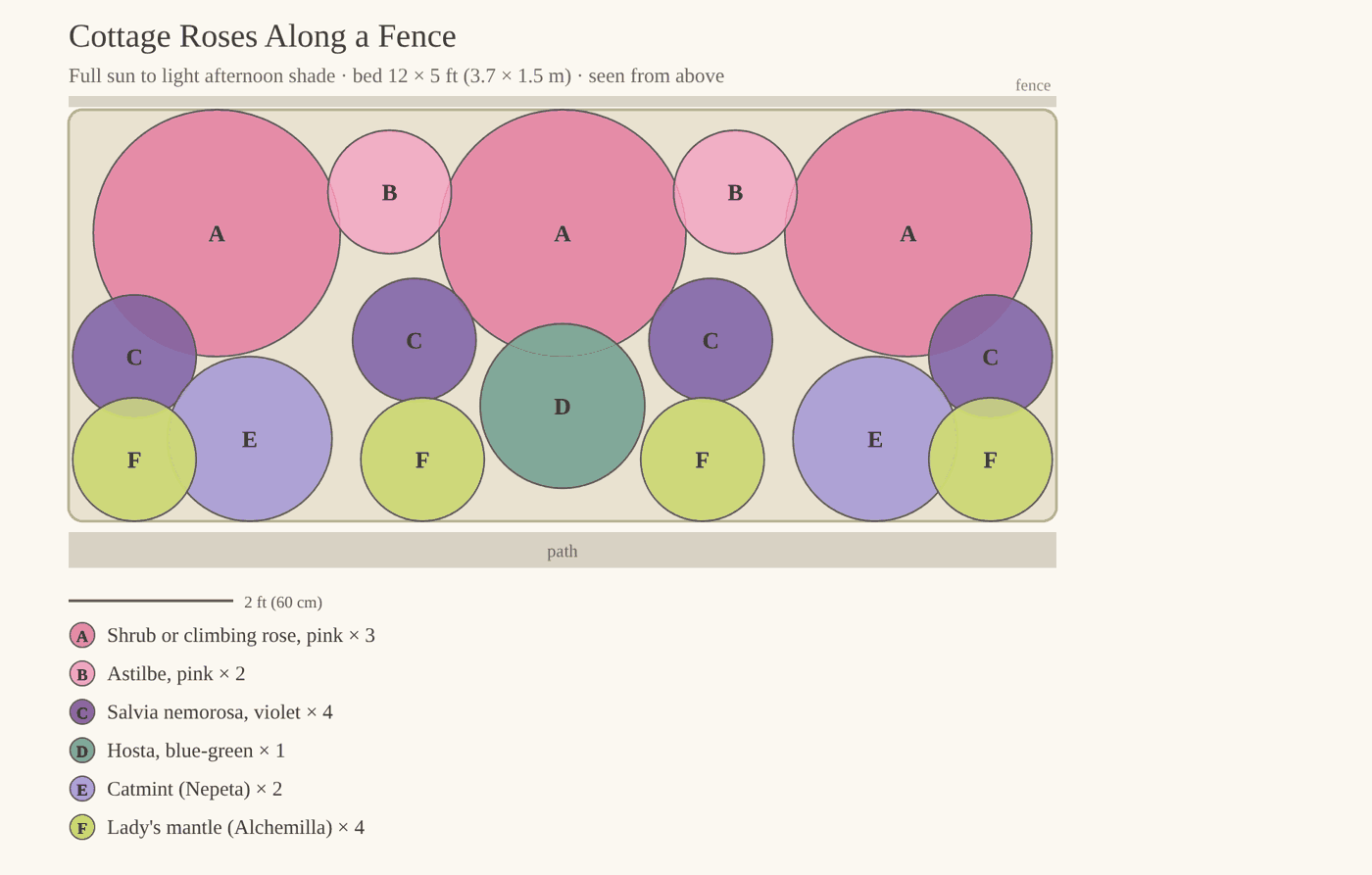
Planting plan: Cottage roses along a fence, seen from above

Plan 2 of 5

Cottage roses along a fence

Full sun to light afternoon shade · bed 12 × 5 ft (3.7 × 1.5 m) · the idea: pink with violet, lifted by lime-green

The classic cottage border: pink roses against a fence, with violet salvia and catmint in front, and the soft lime-green of lady's mantle along the edge. That lime-green is the secret. It makes the pinks and purples look brighter than they could on their own.

You'll need

  • A Pink shrub roses or climbing roses tied to the fence, 3 plants, about 4 ft (1.2 m) apart.
  • B Pink astilbe, 2 plants between the roses. Astilbe likes moist soil, so this plan suits a garden with a little afternoon shade.
  • C Salvia nemorosa, 4 plants.
  • D A blue-green hosta, 1 plant in the middle, for a big round leaf among all the spikes.
  • E Catmint (Nepeta), 2 plants.
  • F Lady's mantle (Alchemilla mollis), 4 plants along the path.

When it's beautiful: June and July, and the hosta and lady's mantle keep it green and full until fall.

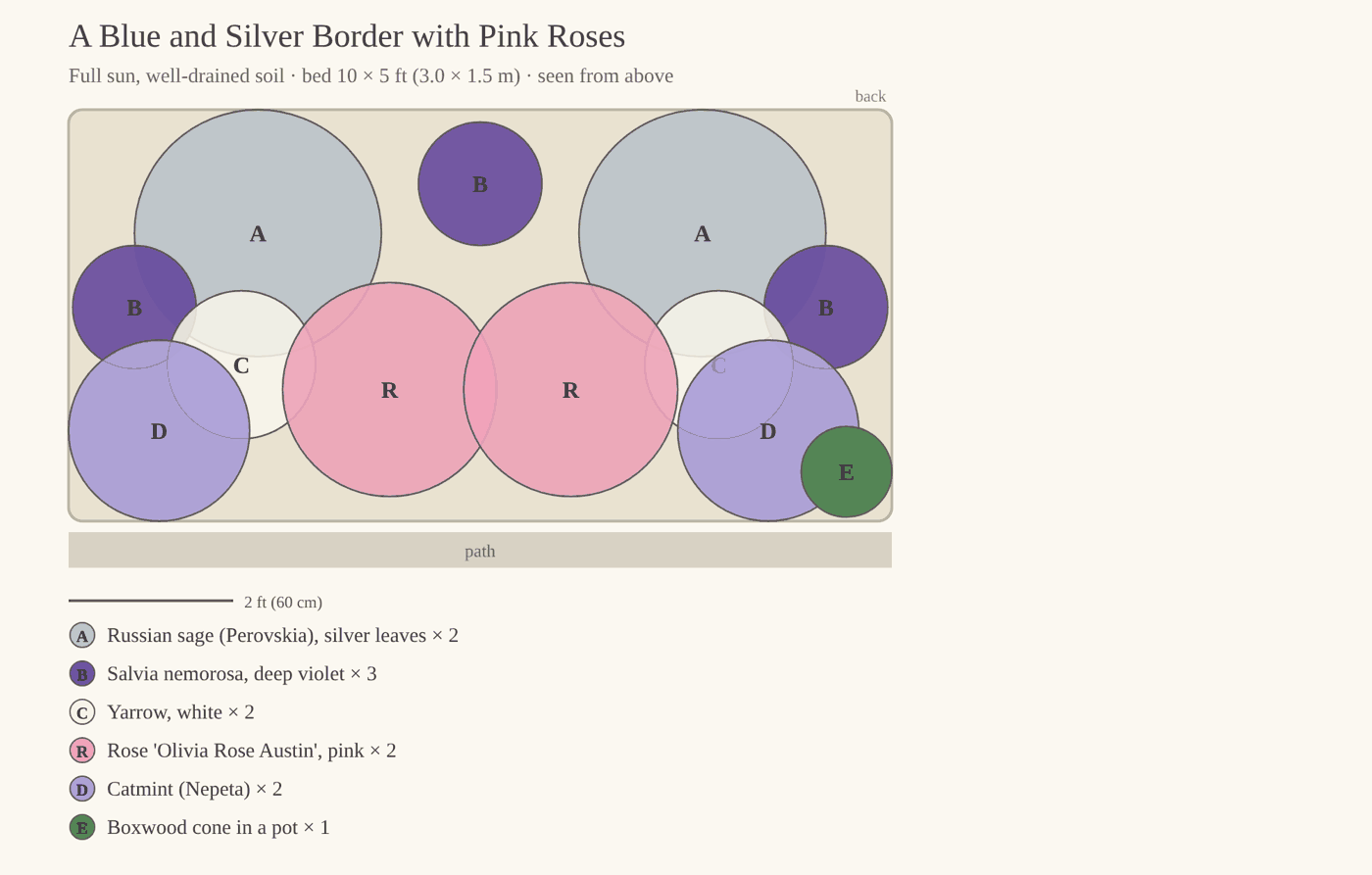
Planting plan: A blue and silver border with pink roses, seen from above

Plan 3 of 5

A blue and silver border with pink roses

Full sun, well-drained soil · bed 10 × 5 ft (3 × 1.5 m) · the idea: shades of blue and violet, warmed by pink

This is the kind of bed I could look at all day: every blue and violet you can imagine, from the deep salvia to the soft haze of catmint, with silver leaves behind and white yarrow to lighten it. In the middle, two pink roses warm the whole picture. A clipped boxwood cone in a terracotta pot at the corner gives the loose planting a little structure.

You'll need

  • A A silver-leaved shrub with blue flowers, such as Russian sage (Perovskia), 2 plants at the back.
  • B Salvia nemorosa in deep violet, 3 plants.
  • C White yarrow, 2 plants.
  • R Rose 'Olivia Rose Austin' from David Austin, 2 plants in the middle, about 2½ ft (75 cm) apart. A soft pink English rose with a lovely fragrance.
  • D Catmint (Nepeta), 2 plants at the front corners. It grows fast, so don't plant it right against the roses.
  • E A boxwood cone in a pot, 1.

When it's beautiful: From early summer to late summer. Shear the salvia lightly after the first flowering for a second show.

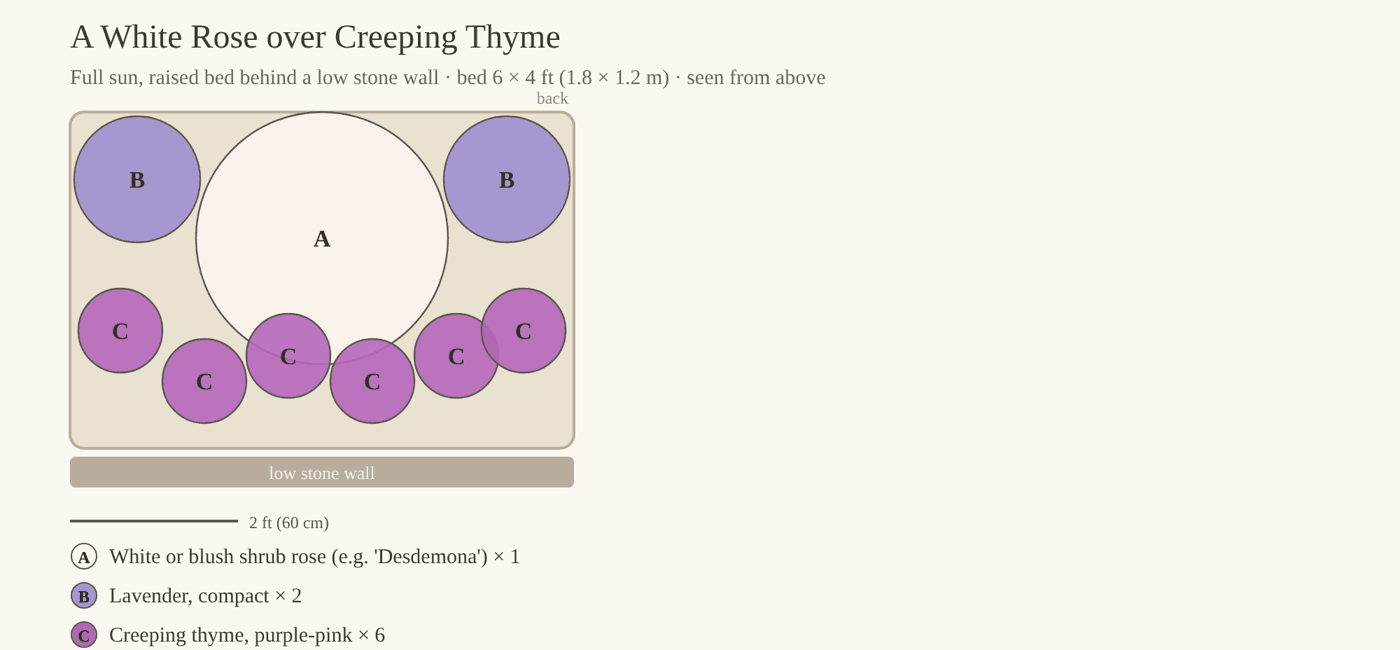
Planting plan: A white rose over creeping thyme, seen from above

Plan 4 of 5

A white rose over creeping thyme

Full sun · a raised bed 6 × 4 ft (1.8 × 1.2 m) behind a low stone wall · the idea: white above, purple below

What I love here is the way the flowering passes from one plant to the other. In spring the creeping thyme along the stone wall lights up with purple flowers while the rose above it is still in bud. Then the rose opens and takes over, and suddenly all eyes are on it. It's a tiny planting, perfect for a sunny corner or the top of a retaining wall.

You'll need

  • A A white or blush shrub rose, such as David Austin's 'Desdemona', 1 plant. For a softer look, 'Earth Angel'; for big fragrant flowers, 'Jeanne Moreau'.
  • B Compact lavender, 2 plants at the back corners.
  • C Creeping thyme with purple-pink flowers, 6 plants, about 12 in (30 cm) apart. Plant some right at the edge so they tumble over the stones.

When it's beautiful: Late spring, when the thyme flowers, then early summer, when the rose takes over. The thyme stays green and fragrant all year.

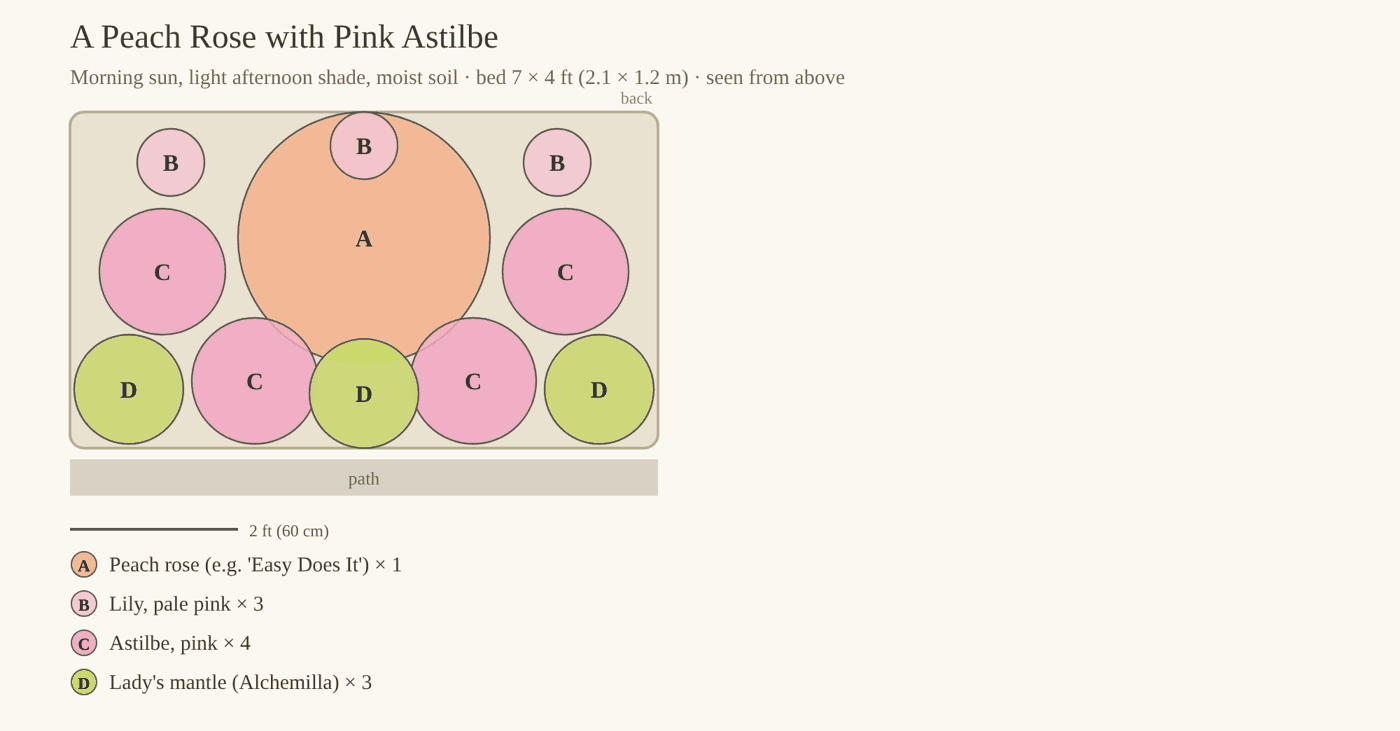
Planting plan: A peach rose with pink astilbe, seen from above

Plan 5 of 5

A peach rose with pink astilbe

Morning sun and light afternoon shade, moist soil · bed 7 × 4 ft (2.1 × 1.2 m) · the idea: soft peach and pink

The peach rose is the soloist. Around it, astilbe with its feathery plumes, and behind it, lilies with their incredible scent. I loved this combination so much that I planted it in my own garden. My peach rose here is 'Easy Does It', a ruffled floribunda that flowers in my garden without a break all summer. Astilbe needs moist soil and a little shade, so keep the bed well mulched and never let it dry out.

You'll need

  • A A peach shrub or floribunda rose, such as 'Easy Does It', 1 plant.
  • B Pale pink lilies, 3 bulbs, planted 6 to 8 in (15 to 20 cm) deep.
  • C Pink astilbe, 4 plants.
  • D Lady's mantle (Alchemilla mollis), 3 plants along the path.

When it's beautiful: Early to midsummer, when rose, astilbe and lilies flower together, and the rose carries on all summer.

Keep planning

Sign In

Register

Reset Password

Please enter your username or email address, you will receive a link to create a new password via email.

Scroll to Top