

There is a moment every rose lover knows: you stand in front of an empty (or chaotic) bed and think, “This could be beautiful… I don’t know where to start.”
In this guide, I’ll walk you through 15 practical principles I use when designing rose beds for small gardens, narrow borders along paths, and larger mixed rose plantings. We’ll talk not only about beauty, but also about health, soil, microclimate, and ease of care — because a perfect rose bed must be both gorgeous and realistic to maintain.
1. Choose One Hero Rose to Lead the Story
The biggest mistake I see is the “rose zoo”: twenty different varieties, all single specimens, fighting for attention.
Instead, pick one hero rose that will be the backbone of the bed:
- Reliable in your climate (good disease resistance in your zone)
- Blooming generously, ideally repeat-flowering
- Shape and height that match the space
Examples of good “hero” roses in many temperate gardens:
- ‘Desdemona’ (David Austin) – soft blush-apricot blooms, strong repeat, beautiful, rounded shrub.
- ‘Queen of Sweden’ – upright, tidy, with elegant, cup-shaped pink blooms.
- ‘Iceberg’ (shrub or climber) – very floriferous white that goes with almost any color palette.
- ‘Lady of Shalott’ – warm apricot-copper tones, strong grower, perfect for a sunset-colored scheme.
Plant your hero not as a single plant, but in repeated groups of 3, 5, or more along the bed. This repetition makes the design read as intentional and calm.
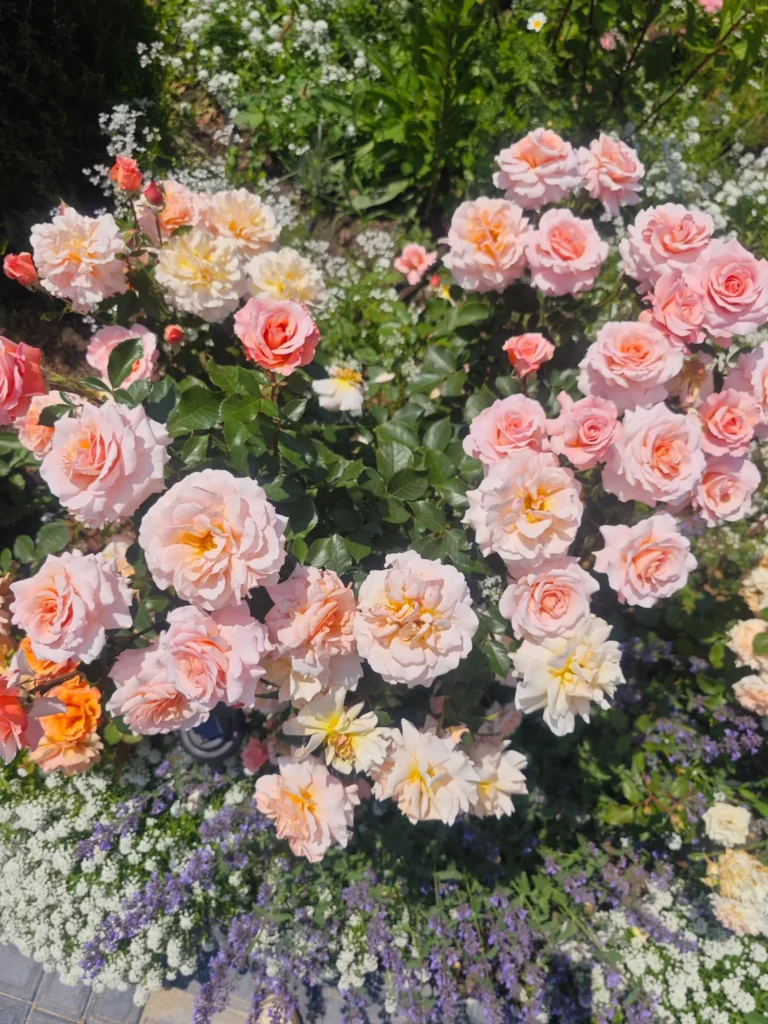
Great expectations rose
2. Plant in Groups, Not as a Collection of Singles
Think in groups and drifts, not as scattered individuals.
- 3–5 bushes of ‘Desdemona’ together create a creamy-blush “cloud” of color.
- A drift of ‘Koko Loko’ (with its unusual latte-lilac tones) is repeated in two spots, tying the bed together.
- Three ‘The Fairy’ (soft pink, small blooms, excellent groundcover) at the front edge make a continuous ribbon.
As a rule of thumb:
If you love a variety enough to buy it, plant it at least three times in the design.
Fewer varieties, repeated more often, almost always look more elegant than one of everything.
3. Use the Color Wheel to Build a Clear Color Story
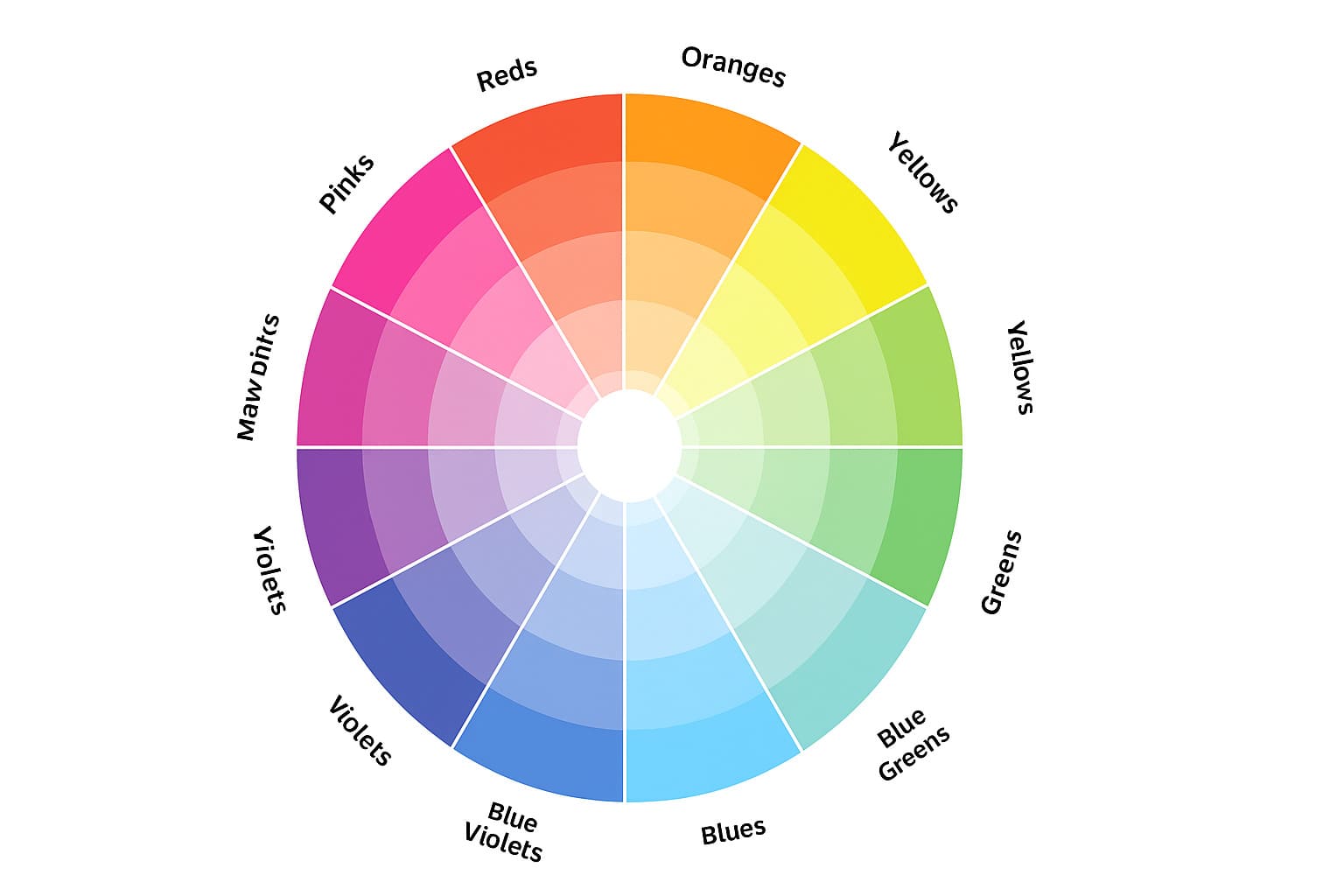
Before you buy anything, decide what color story your bed will tell. The color wheel is your friend in this case.
You can build harmony in three simple ways:
3.1. Analogous Colors (Neighbors on the Wheel)
These are colors that sit next to each other on the color wheel. They create calm, soft transitions.
- Pinks → apricots → soft yellows
- Example palette: ‘Desdemona’ (blush), ‘Roald Dahl’ (soft apricot), ‘Golden Celebration’ (warm yellow)
- Companions: blue catmint, soft lavender, silvery foliage
Result: a gentle, romantic rose bed that never screams.
3.2. Complementary Colors (Opposites on the Wheel)
These are colors that are opposite to each other — high contrast, energetic.
- Deep magenta rose with lime-green foliage or chartreuse companions
- Warm yellow roses with lilac-purple salvias
- Example: ‘Lady of Shalott’ (apricot-orange) with salvia ‘Caradonna’ (deep purple)
Use complements carefully: let one side dominate and the other appear as an accent, not 50/50.
3.3. Monochrome with Nuances
Pick one color family and play with depth and value:
- All pinks: pale blush, shell pink, deep rose
- All whites and creams with touches of soft lemon
Example palette:
- ‘Claire Austin’ (cream), ‘Tranquillity’ (white), ‘Vanessa Bell’ (pale lemon)
- Companions: soft grasses, white foxgloves, silvery foliage
This works exceptionally well near terraces and seating areas, where you want to create a peaceful mood.
Whatever you choose, stick to one primary palette per bed. You can still add subtle surprises, but let the main story be clear.
4. Layer by Height: Tall, Medium, Low
Imagine your rose bed as a bit of forest:
- Upper layer – tall shrubs, climbers, or standards
- Middle layer – classic bush roses (80–120 cm)
- Lower layer – groundcover roses and companion plants
For a bed viewed mainly from one side (along a path or fence):
- Back row (tall):
- Climbing ‘Eden’ (‘Pierre de Ronsard’), ‘Teasing Georgia’, or ‘New Dawn’ on trellises or arches
- Larger shrubs like ‘The Generous Gardener’ or ‘Charles de Mills’
- Middle row:
- ‘Desdemona’, ‘Queen of Sweden’, ‘Lady of Shalott’, ‘Roald Dahl’, ‘Boscobel’
- Front row:
- Compact roses like ‘The Fairy’ or low polyanthas
- Companion plants (lavender, catmint, hardy geraniums, alchemilla, thyme, sedum)
For an island bed visible from all sides, place the tallest roses towards the center and step down in height as you move to the edge.
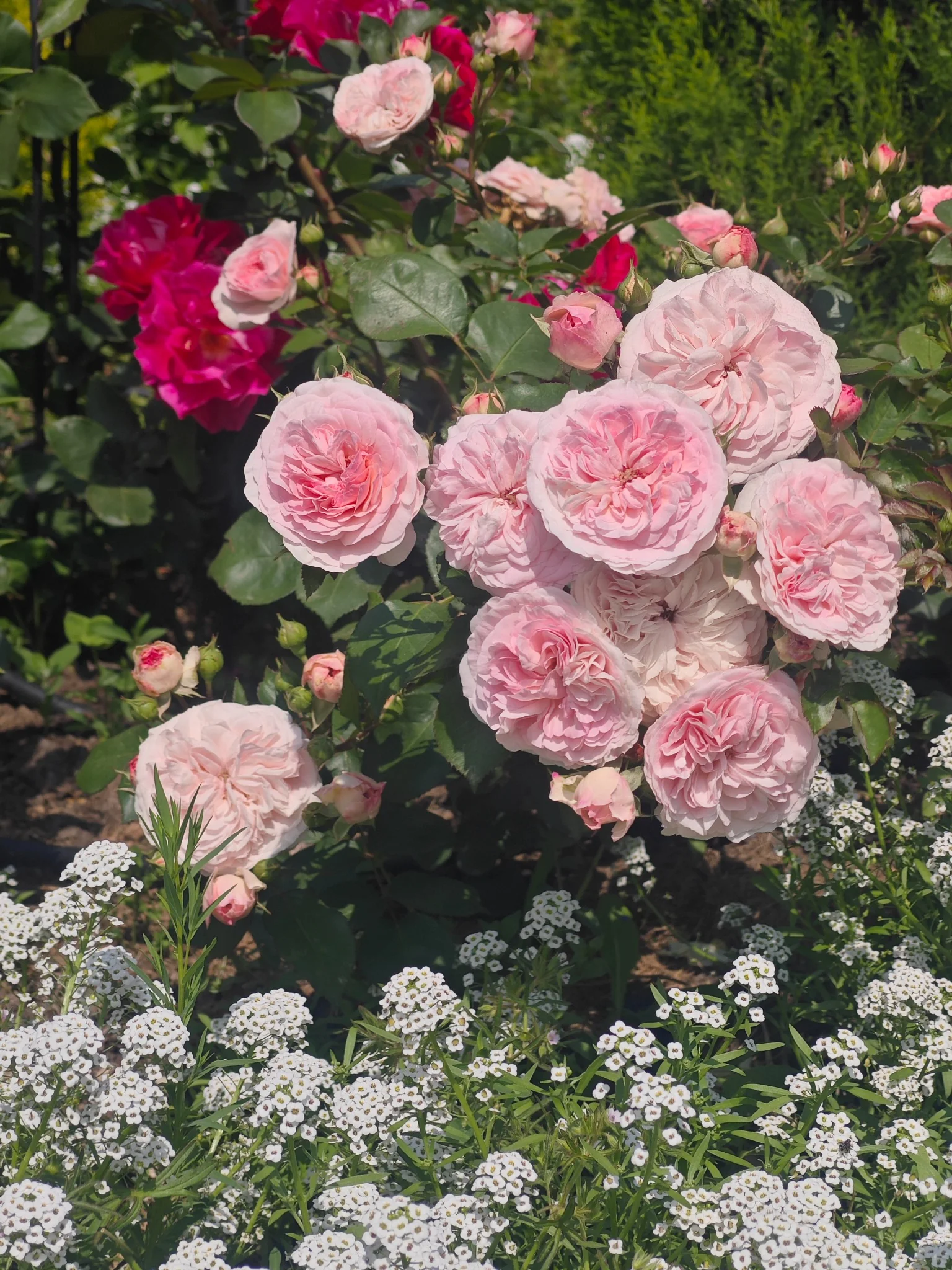
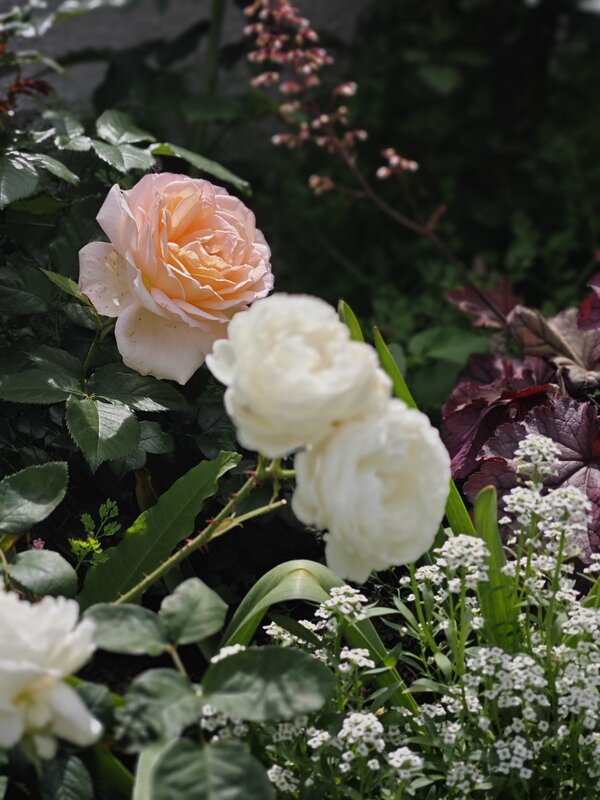
Guy Savoy rose, Maria Theresia rose, and Alyssum
5. Draw Shapes, Not Dots (Plan in Drifts)
Before planting, take a pencil and draw the bed from above:
- Outline the shape of the bed
- Draw large ovals for groups of roses (each oval = 3–5 plants of the same variety)
- Add smaller shapes around them for companion plants
Think in terms of pools of color:
A pool of ‘Desdemona’ here, a pool of ‘Lady of Shalott’ there, connected by a “river” of lavender along the edge.
This simple sketch helps avoid the trap of “there is space for one more rose” (there is always space if you dig hard enough – but the design will suffer).
6. Create a Focal Point Your Eye Can Rest On
A beautiful rose bed almost always has a center of attention:
- An arch with a climber like ‘Eden’ or ‘The Generous Gardener’ over a path
- A white obelisk with ‘Claire Austin’ winding around it
- A rustic bench framed by two fragrant shrub roses
- A large container with a standard rose in the middle of the bed
Stand where you most often look at the bed (terrace, kitchen window, garden gate) and place your focal point for that view, not for the side where you rarely stand.
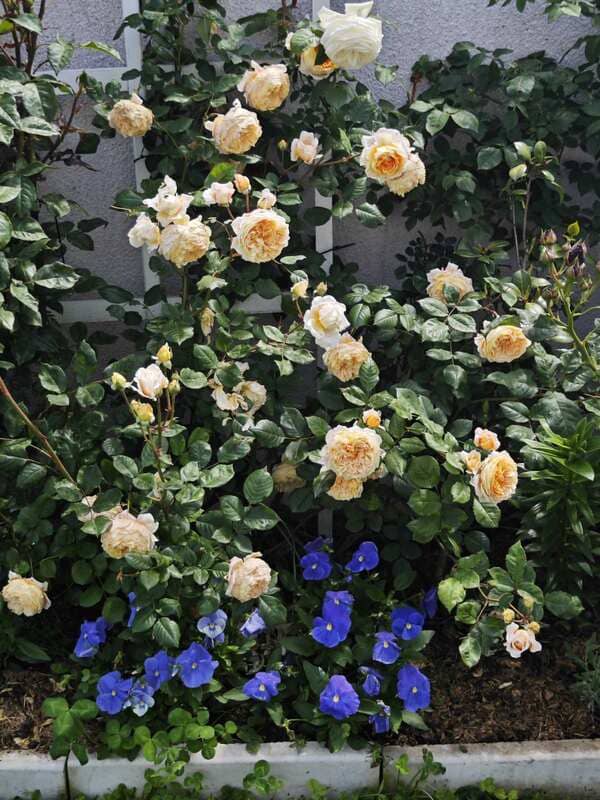
Crown Princess Margareta rose with violas
7. Work With Your Microclimate (Sun, Wind, Air)
Roses don’t live in a vacuum. Your bed must match your real conditions:
- Sun: Roses require at least 6 hours of sunlight; morning sun is especially beneficial, as it helps leaves dry quickly after dew and rain.
- Wind: Gentle air movement is good; strong, funnelled wind between two walls is not—shelter tall roses from harsh prevailing winds.
- Air circulation: Avoid planting roses pressed tightly against a solid fence with no airflow; leave a little breathing space behind them.
Choose tougher, more disease-resistant varieties for damp, shady corners, and keep your most delicate divas in areas that receive good morning light and quick drying.
8. Choose Companion Plants That Work, Not Just Look Pretty
Good companion plants are not just decoration. They help:
- Shade the soil and reduce evaporation
- Attract pollinators and beneficial insects
- Add texture and color when roses are between flushes
Reliable companions for roses:
- Lavender (‘Hidcote’, ‘Munstead’) – classic pair; loves similar conditions, adds fragrance and structure.
- Catmint (Nepeta ‘Walker’s Low’) – soft blue haze at the front, very long blooming, bees adore it.
- Hardy geraniums (e.g., Geranium ‘Rozanne’) – fill gaps, flower for months, soften edges.
- Alchemilla mollis (Lady’s mantle) – lime-green frothy flowers, beautiful contrast with pink roses.
- Salvia nemorosa (‘Caradonna’, ‘Mainacht’) – vertical accents in purple/blue, good for warm palettes.
- Ornamental grasses – Stipa, Pennisetum, and others bring movement and autumn interest.
Avoid extremely aggressive spreaders (certain mints, ground elder, etc.) directly in the rose bed — they will compete with roots and are hard to remove.
9. Plan for Beauty From Spring to Frost
Roses have peaks and pauses. Your bed should never look completely “empty”.
Early Spring
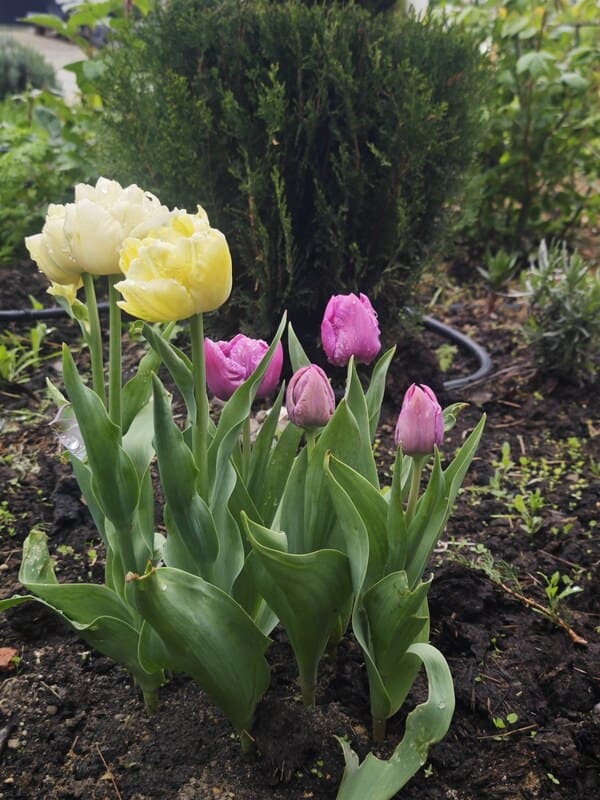
- Plant bulbs between roses, such as tulips, daffodils, and muscari.
- They flower before the roses leaf out and then quietly disappear under summer foliage.
Early–Mid Summer
- Main rose show, supported by catmint, salvia, hardy geraniums, foxgloves, and delphiniums.
Late Summer–Autumn
- Repeat-flowering roses are still blooming.
- Add grasses, sedums, Japanese anemones, and, if you grow some species or shrub roses, enjoy their hips as autumn decoration.
Aim for at least 30–40% of the bed’s beauty to come from plants other than roses. That is your insurance for off years, poor weather, or a harsh pruning.
10. Build Everything on Living Soil
The most beautiful rose bed starts underground.
- Loosen compacted soil deeply before planting, breaking any hardpan.
- Work in good compost rather than relying only on bagged fertilizers.
- Avoid solid plastic weed membranes under roses — they suffocate soil life and roots.
Use organic mulch (shredded leaves, grass clippings, well-rotted compost) to:
- Feed soil biology
- Keep moisture in
- Protect roots from heat and cold
Healthy soil = stronger immunity = fewer pests and diseases, and richer color and fragrance in your blooms.
11. Make Maintenance Easy From Day One
A perfect design on Pinterest means nothing if you cannot weed, prune, or water without gymnastics.
- Keep the bed width realistic: if you can access only from one side, aim for a depth of around 1.0–1.2 m.
- Create small stepping stones or a discreet inner path in larger beds, so you can reach the center without compacting the soil.
- Install or plan for drip irrigation, especially in hot climates or when you travel in the summer.
Ask yourself honestly:
“Can I reach each rose with my secateurs without stepping into the bed?”
If the answer is no, adjust the layout now — it’s much easier than after planting.
12. Get Scale and Spacing Right So Roses Can Breathe
Most catalog photos are cleverly cropped. In real life, roses become bigger and broader than many gardeners expect.
General spacing guidelines:
- Medium shrub roses: 60–90 cm apart
- Large shrubs and vigorous Austins: 1.0–1.2 m apart
- Climbers: 1.8–2.5 m apart along a wall or fence (depending on vigour)
Leave enough air between plants so the center of the bush does not become a dense, humid tangle. Air and light are as crucial to disease prevention as any spray or medication.
13. Repeat the Shape of the Bush and the Bloom
Color is not the only thing that creates harmony.
Our eye also reads shape — both the shape of the bush and the bloom.
If you mix too many different “rose personalities” in one small border (very upright, very arching, very stiff, very floppy), the bed can start to feel restless.
Try to repeat:
- Similar bloom shapes
- Cup-shaped, quartered, rosette, classic “goblet” hybrid tea
- Similar bush habits
- Rounded, fountain-like, or more vertical
For example:
- A pastel bed built mostly on rounded, cupped David Austin roses like ‘Desdemona’, ‘Olivia Rose Austin’, and ‘Eglantyne’ will look naturally cohesive, because the blooms all share a soft, romantic shape.
- A warmer, more modern bed could repeat the elegant “goblet” form of hybrid teas such as ‘Pascali’, ‘Elle’, or ‘Apricot Queen Elizabeth’, with a few shrub roses that echo the same upright habit.
You can mix shapes — a few fountain-like bushes or a narrow pillar rose can be wonderful accents — but let there be one main line:
Most of your roses are rounded and soft, and vertical shapes appear only as highlights.
Or, most are upright and formal, with arching roses appearing in just one or two focal points.
This subtle repetition of form is what makes a bed feel calm and well-designed, even with many varieties.
14. Use Clean Backgrounds and Edges to Make Roses Shine
Sometimes a rose bed looks “messy” not because of the roses, but because of the background and edges.
A few simple choices change everything:
- A neat front edge – a ribbon of Stachys byzantina (lamb’s ear), low lavender, hardy geranium, or even a simple brick or stone edging. This visually “holds” the bed together and stops soil and mulch from spilling onto the path.
- A quiet background – a clipped green hedge, a plain painted fence, or a simple trellis.
When the background is calm, the roses can finally sing.
Beautiful combinations:
- Soft pinks and creams like ‘Desdemona’ and ‘Claire Austin’ against a plain dark green hedge or a soft grey fence.
- Warm apricots and yellows like ‘Lady of Shalott’ and ‘Roald Dahl’ in front of a simple, light-colored wall, without extra patterns.
Try to avoid visual noise right behind the roses:
- Very busy, multicolored fences
- Too many different materials in one short stretch (brick, metal, wood, stone, all together)
- Lots of small garden ornaments are scattered everywhere
The simpler your background and edging, the more expensive and “designed” your roses will look — even if the plants themselves are very ordinary.
15. Add Evening Light for a Garden That Glows After Sunset
Many of us actually enjoy our gardens most in the evening – after work, with a cup of tea or a glass of wine.
A truly perfect rose bed should also be beautiful at dusk.
Think about soft, warm lighting:
- Small garden lights along the path and near the main rose groups
- A few discreet spotlights aimed at a climber, an arch, or your favorite shrub rose
- Warm colour temperature (around 2700–3000 K) so petals look gentle and creamy, not harsh and blue
White and pale roses like ‘Iceberg’, ‘Tranquillity’, or ‘Claire Austin’ glow almost like little lanterns in evening light. Soft pinks and apricots also look wonderful under warm LEDs.
Place the lights where you actually live your evenings:
- Beside the terrace where you sit
- Along the path, you walk back to the house
- Near the focal point, you see from the kitchen window
You do not need a complicated system. Even a few well-placed, low-voltage lights can turn your rose bed into a quiet, glowing scene and extend the time you spend with your garden beyond daylight hours.
Want a Ready-Made Plan for Your Small Space?
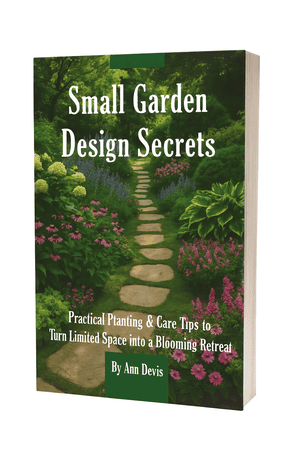
If you’re reading this and thinking, “I don’t just want one rose bed – I want my whole tiny garden to make sense,” my book was written exactly for you.
Inside, you’ll find:
Ready-made layouts for tiny yards, courtyards, and balconies, including rose-focused borders
Simple formulas for choosing the right roses for pots (height, roots, fragrance, winter care)
Container “recipes” where roses, companions, and colors are already combined for you
Practical tips on soil, watering, and microclimate so roses thrive even in limited space
Ideas for turning one small corner into a calm, personal retreat, not just a collection of plants
If you’d like step-by-step guidance beyond this article, you can find the book on Amazon:
“Small Garden Design Secrets” by Ann Devis
Frequently Asked Questions About Designing a Rose Bed
Begin with three decisions:
- The shape and size of the bed (measure it, draw it).
- Your color story is based on the color wheel (soft analogous tones, gentle monochrome, or a few complementary accents).
- One or two hero roses that you will repeat in groups.
Then sketch the bed from above, placing ovals for groups of the same variety and adding companions around them. This simple drawing will keep you from random impulse planting.
It depends on the bed size and rose types, but a typical pattern is:
- Medium bed (about 1.5 × 4 m): 6–8 shrub roses plus companion plants
- Larger bed (around 2 × 6 m): 10–14 shrub roses plus climbers and companions
Aim to plant fewer varieties but more of each: groups of 3–5 of the same rose look much more elegant than many single specimens squeezed together.
The best companion plants:
- Enjoy full sun and similar soil conditions
- Do not compete too aggressively for water
- Offer long flowering or attractive foliage
Good options include lavender, catmint, hardy geraniums, Lady’s mantle, salvias, ornamental grasses, and spring bulbs. They shade the soil, attract beneficial insects, and add texture and color between rose flushes.
Combine roses with plants that offer beauty from early spring to late autumn:
- Spring: bulbs like tulips and daffodils under and between roses
- Summer: repeat-flowering roses plus long-blooming perennials such as catmint and geraniums
- Autumn: grasses, seedheads, rose hips, and late perennials like Japanese anemones
Choose at least a few plants that carry beauty outside the main rose flushes. This way, the bed never feels “empty”.
As a practical baseline:
- Most shrub roses: 60–90 cm between plants
- Larger and more vigorous varieties: up to 1.2 m
- Climbers: 1.8–2.5 m along a wall or fence
Proper spacing allows roses to develop a full, healthy shape and ensures adequate air and light circulation, which helps prevent disease.
Pick a simple, quiet background and a neat front edge:
- Background: a plain painted fence, a clipped green hedge, or a simple trellis in one colour. This lets the blooms stand out.
- Edging: a low ribbon of plants like lavender, lamb’s ear, or hardy geranium, or a small brick or stone border. This holds the bed visually and keeps soil and mulch off the path. Avoid too many different materials and busy patterns directly behind the roses. The calmer the background and edges, the more refined and intentional your rose bed will look.


