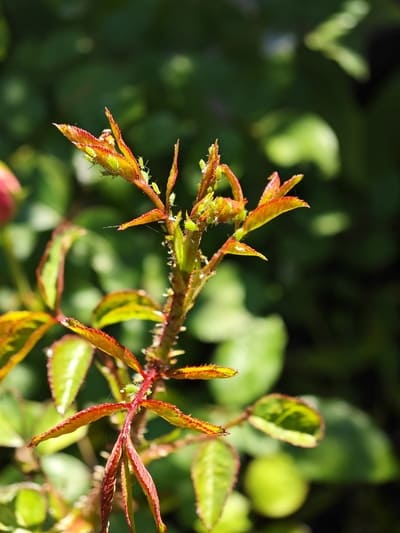
If your roses aren’t growing well every year… It’s probably not because they’re not fertilizing enough. I know. We’ve all been told that. Spring comes, we grab a packet of rose fertilizer, sprinkle it on, water it, and wait for the magic to happen. I did that too. And many gardeners believe that the more they sprinkle, the better it will be for their roses. And for a while, it seems to work. It’s a pleasant feeling that you’ve “done something.” Large, green shoots. Rapid growth…and aphids! We don’t connect the dots; of course, we think we were just unlucky, the weather was so bad, etc. But unfortunately, we’ve done it ourselves. The leaves become loose from excess nitrogen, and the result: you’ve created the perfect meal for aphids; they’re now perfectly comfortable sucking the juices out of your roses. Aphids will give you a Michelin star and happily devour the dish. Then comes summer. Black spot. But why? It’s the same old story: the leaves are loose, despite active growth – it’s easy for fungus to penetrate the leaf blade. And then, hello black spot, powdery mildew, and all the other fungal delights. Then? Weak second blooms. Stems are too soft to properly support flowers. The soil is salty, nutrients are trapped in the soil, and what do we do next? We take the familiar bag and sprinkle it again, as if there wasn’t enough the first time. It’s a vicious cycle, believe me.
That’s when I realized something unpleasant. I wasn’t growing roses. I was managing their reactions.
The Mistake Most Gardeners Don’t See
Here’s the quiet truth. Roses don’t eat fertilizer. They eat what the soil life prepares for them.
Imagine: if your soil were a kitchen, microbes would be the cooks. They take raw ingredients, leaves, compost, organic matter, and slowly transform them into balanced food that the roots can actually digest.
When you sprinkle mineral fertilizer into the soil, you’re not feeding the kitchen. You’re pouring energy drinks directly into the plant’s bloodstream. Sure, it revives. But it doesn’t strengthen it. The plant becomes dependent on your feeding. The package says nitrogen, phosphorus, and potassium. Well, at best, about 10 more micronutrients. And you might not even suspect that your plant lacks molybdenum, or zinc, or nickel, or dozens of other elements not in your package. And only the underground food chain, which includes thousands of species of bacteria, fungi, and other microorganisms, a whole team that nature has already expertly prepared for your garden, can supply this.
Mineral fertilizers are salts. They dissolve quickly, stimulate rapid growth, and bypass the entire biological system underground. Over time, this “shortcut” weakens the soil community. Fewer fungi. Less microbial diversity. Poorer structure. And structure matters more than people think.
Soil isn’t just earth that holds roots upright. It’s a living sponge. It retains water. It balances air. It stores nutrients in a stable form. When this structure is destroyed, the roots remain shallow. Plants become thirsty more quickly. Diseases appear more frequently.
Then we blame the weather. Or the variety. Or ourselves. But the real problem lies underground.
Why Soil Fertilization Works (Even Slowly)
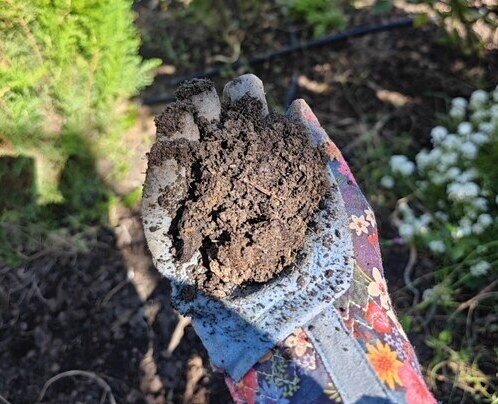
When you fertilize your soil, you restore its “kitchen.” You add carbon and organic matter. Real food for microbes. Compost doesn’t feed roses directly. It feeds bacteria and fungi. They process it gradually. They buffer the nutrients. They create stable aggregates in the soil, allowing water to drain but not disappear. It happens more slowly. And that’s why it works. Healthy soil releases nutrients when the plant really needs them. Slowly. Not abruptly. Gradually. Steadily. The way real growth occurs.
When you stop sprinkling synthetic fertilizers on the soil, stop constantly tilling and disturbing the soil, and stop poisoning your garden with chemicals, a miracle happens: the mycorrhizal network begins to grow, feeding your plants. As Elaine Ingham says, “Plants order nutrients from mycorrhizae like pizza delivery.” Roses stop living in a state of deficit and stress.
Have you ever walked in the forest? Notice how lush everything is? And no one is fertilizing or running around with a sprayer. Why do you think that is?
I observed this change in my own garden. The first season after I stopped using synthetic fertilizers, growth was calmer. Less rapid. I admit, I was a little worried.
But by the second year? Deeper roots. Fewer fungal diseases. More abundant repeat blooms. And less of that constant maintenance that used to take up my weekends. That’s when it all became clear. Roses aren’t fragile. Unstable soil systems are.
What To Do This Spring Instead
If you’re standing in your garden right now, wondering what to give your roses… pause for a moment. Don’t reach for fast-release fertilizer. Ask yourself: what does my soil need to wake up properly?
In spring, soil life is just getting started. Microbes need organic matter to rebuild populations after winter. They need carbon. They need material to process. So give them that.
A thin layer of well-aged compost around the base of each rose, not piled against the stems, just spread gently over the root zone, is enough. Two or three centimeters. That’s it. No heavy feeding. No chemical push. If you don’t have compost, leaf mold works beautifully. So does fully decomposed manure. Even shredded leaves can help rebuild that protective surface layer.
You’re not feeding the plant. You’re rebuilding the system that feeds the plant. Without that system, everything else is random.
Why Mineral Fertilizers Become a Dead End
Repeated use increases soil salt concentration. Microbial diversity decreases. Organic matter content diminishes. The soil gradually loses its buffering capacity. As a result, you get a plant that grows rapidly but reacts to any stress, heat, drought, or disease, because it lacks stable support. It becomes a vicious cycle. Weak soil — more fertilizer — even weaker soil.
And this creates a sense of productivity because you’re constantly “doing something.” But stable gardens don’t need constant intervention. They regulate themselves. Let go of the constant controller and listen to your garden for what it truly needs.
What You Should Stop Doing
You must understand that the appearance of a fungal disease on a rose, for example, is not the cause; it’s a consequence of the factors currently present in your garden. And the first thing you need to do is look under your feet, look where your rose is growing. Because the soil is everything.
If the soil is compacted, fertilizers won’t help. If the biological resources are depleted, soluble nutrients won’t restore them. This is where most gardeners get stuck. They look at the leaves. The answer lies in the soil.
Who This Approach Is Really For
If you want your roses to grow stronger each year with less effort, then this is where you need to start.
The first season will require a little patience. You’re restoring the foundation, not decorating the roof.
But once the soil recovers, everything will stabilize. Watering becomes easier. The risk of disease decreases. Flowering cycles will even out.
And gardening becomes more peaceful. There are fewer emergencies.
Free rescue guide
Bring Your Roses Back to Life
A one-week rescue plan for a struggling rose
Free rescue guide
Bring Your Roses Back to Life
My free one-week rescue plan for a struggling rose, with seven step-by-step plans and my favorite homemade revival recipes. Join my garden letters, and it's yours.
Bring Your Roses Back to Life
My free one-week rescue plan for a struggling rose, with seven step-by-step plans and my favorite homemade revival recipes. Join my garden letters, and it’s yours.
Thank you!
Check your inbox in a few minutes. Your rescue guide is on its way. If you don’t see it, check your Promotions or Spam folder.
How to switch from synthetic to organic fertilizers without harming your roses?
Here’s what’s often overlooked:
Don’t replace fertilizers with “nothing.” Immediately replace them with organic fertilizers — good compost, alfalfa meal, seaweed fertilizer, fish emulsion, herbal infusions, etc. I provide many recipes for organic fertilizers in my books.
I switched to foliar application in the first year, but significantly reduced the amount of mineral fertilizer. For example, instead of 100 ml of chelated mineral complex, I applied one teaspoon per 5 liters. The roses bloomed beautifully. It was an AHA moment when I realized I didn’t need kilograms of mineral fertilizer.
What’s most important during the transition phase:
Cover the soil (mulch protects microorganisms).
Don’t add mineral fertilizers to the soil; it’s better to spray a chelated fertilizer on the foliage.
Don’t overwater the soil (waterlogged soil stifles microorganisms).
The goal isn’t to “feed less.” The goal is to restore the functions of underground ecosystems so that feeding becomes a secondary task. This is the first step. Without restoring soil structure, organic methods seem slow and frustrating.
What compost is best for roses, and how can I make or find it?
The best compost for roses is fully mature, dark, crumbly, and earthy-smelling. It shouldn’t smell sour. It shouldn’t be hot to the touch. You shouldn’t be able to recognize the original materials. Immature compost competes with plants for nitrogen. This is a common mistake.
I did this the first year; I bought good compost while I was making mine. And the second year, I had my own free compost. Now you’re asking me how I can make so much compost myself? The truth is, I actually need a lot of it; a thin layer on top of the soil or in the planting hole is enough.
What works best:
Leaf mold is great for creating structure. It improves moisture retention and fungal balance.
- sifted material
- free of large woody pieces
- no strong odor
- stable, fine-grained texture
What should you do if your roses show signs of nutrient deficiency or disease during the transition period?
Many “problems” are actually root stress.
Adjust one parameter at a time. Most roses don’t wilt during the transition. They adapt.
How long does it take to see improvements?
If You’re Trying to Figure Out What Your Plants Are Really Telling You
In “Why Doesn’t My Rose Grow and Bloom? – 100 Reasons and Solutions”, I break down those real causes clearly and directly. No fluff. Just diagnosis and correction.
If you want to track what actually happens in your garden instead of guessing, the Rose Garden Planner 2026 – Log Book helps you see patterns in soil care, bloom cycles, and growth responses over time.
And if you’re ready to fully shift to a soil-first system, “Revolution in the Rose Garden – Organic Rose Gardening” explains how to rebuild your garden from the ground up, step by step.
Because when soil works, roses stop struggling. And you stop fighting your garden.
Rose gardening books

Step into a calmer, more confident rose season. With Ann Devis’s rose gardening books and planner, you’ll get simple organic routines, proven tips, and checklists that keep your roses thriving – from first bud to last bloom.