Bone meal for garden
Gardeners often tout bone meal as a magic ingredient when planting roses or reviving blooms. But is it truly necessary? In this guide, you’ll learn:
- What bone meal is and how it works
- When roses might benefit from it — and when it’s wasteful or harmful
- How to test your soil and interpret phosphorus signals
- How to apply it (if you should)
- Common mistakes and alternatives that often outperform it
Let’s demystify bone meal for your rose garden.
What Is Bone Meal?
Bone meal is an organic amendment made by finely grinding animal bones (most commonly cattle). It is naturally high in phosphorus (P₂O₅) and calcium, and releases nutrients very slowly into the soil over time.
Because phosphorus doesn’t move or leach easily, bone meal benefits the root zone if placed appropriately. But its usefulness strongly depends on soil pH and existing phosphorus levels.
Why Might Roses “Care” About Bone Meal?
Phosphorus is crucial for root development, flower initiation, and energy metabolism in plants. In theory, giving roses extra P encourages stronger roots and better blooms.
However:
- Many home soils already contain adequate phosphorus.
- Excess P can lock up micronutrients (iron, zinc, manganese) or suppress beneficial fungi (mycorrhizae).
- In alkaline or calcareous soils (pH ≥ 7), phosphorus becomes chemically bound and less available, making bone meal ineffective.
- Blooming is influenced by many factors beyond P (light, pruning, water, vigor, genetics)
Thus, bone meal is not a universal necessity—it’s conditional.
How to Check If Your Garden Needs Bone Meal
1. Do a Soil Test (Best Route)
Send a soil sample to a laboratory and look for the “available phosphorus index” (e.g., via Mehlich-3 or Bray extraction). If P is in the medium to high range, skip bone meal.
This is the most accurate and defensible method—even if it incurs a slight cost.
2. Watch for True P Deficiency Signs (Use Caution)
Symptoms are subtle and overlap with other issues:
- Stunted growth, weak root systems
- Delayed or sparse buds
- Older (lower) leaves are taking on a purplish or bronzy tint
However, in cool spring soils, that purple may appear even when phosphorus is adequate—so treat this as a signal, not proof.
3. Prioritize Soil pH
If your soil is alkaline (pH ≥ 7), phosphorus is more likely to be tied up. Bone meal will not reliably help until pH is corrected (towards acid/neutral).
4. Don’t Use Bone Meal as a Bloom Band-Aid
Many gardeners default to P additions, thinking “more phosphorus = more flowers.” However, bloom count depends heavily on factors such as light, air circulation, variety vigor, water, and pruning timing, rather than just one nutrient.
Diagnosing Too Little vs. Too Much Phosphorus
Phosphorus Condition: Common Visual & Growth Clues
Too Little (P deficiency): Slow shoot growth, delayed budding, purpling of lower leaves, weak roots
Too Much (P excess / induced micronutrient deficiency) Interveinal chlorosis on newer/top leaves (lack of Fe, Zn, Mn), buds are small, though shoot growth continues.
Because excess P often shows indirect symptoms (micronutrient lockout), it can masquerade as a deficiency of iron or zinc.
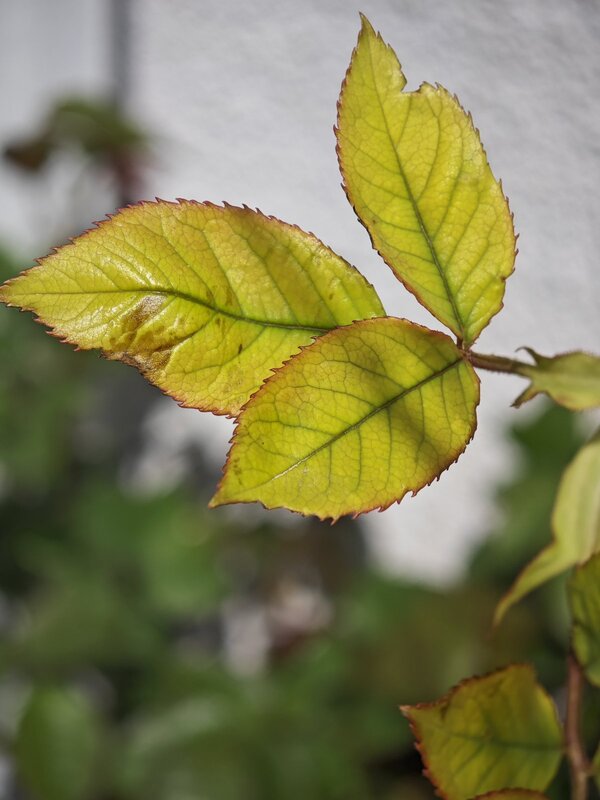
chlorosis on rose leaf
To guard against misdiagnosis:
- Check pH (6.0–6.8 is ideal for rose nutrient uptake)
- Review fertilizer history (have you used bone meal or high-P products repeatedly?)
- Compare top vs. bottom leaves (lower leaf purpling vs. upper leaf chlorosis)
- Consider soil and root conditions (cold, compaction, low organic matter often mimic P problems)
- In pots, nutrient buildup occurs faster—flush or repot as necessary.
How to Apply Bone Meal (If You Decide It’s Needed)
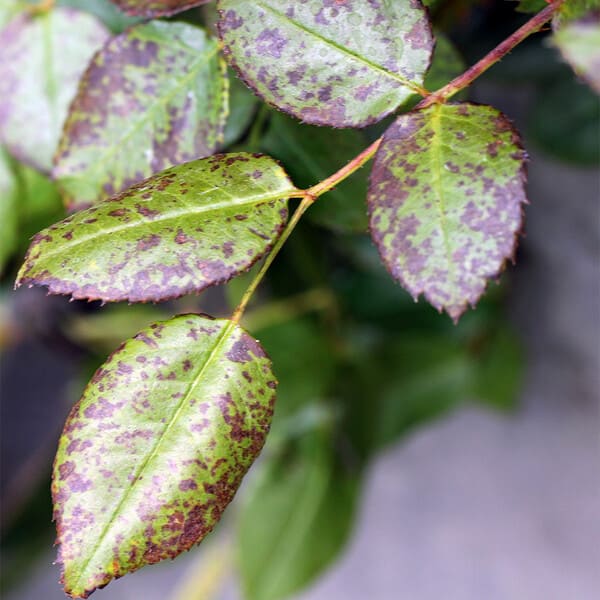
Phosphorus deficiency in roses
If your soil test shows low available P and pH < 7:
- Where: Mix into the root zone, up to the upper 10–15 cm (4–6 in). Don’t just sprinkle on the surface — phosphorus doesn’t travel far.
- When: At planting, or early spring. Apply in the fall only if the soil doesn’t freeze solid and the pH is suitable.
- How Much: Follow the label. Because bone meal is slow, more is not better.
Pet Safety: Dogs love the smell — bury it well and water it in immediately to discourage digging.
Common Mistakes & Pitfalls
- Using bone meal in alkaline soils (ineffective P availability)
- Following the tradition of “one cup in the hole” without verifying the need
- Treating bone meal as a panacea for poor flowering (ignores light, pruning, water)
- Piling on high-P products and suppressing mycorrhizal colonization
- Letting excess P run off into waterways
Alternatives & Fundamental Soil Strategies
Often, improving soil structure, biology, and organic matter yields more reliable results than tweaking fertilizers.
- Use compost, living mulches, and good drainage to support root health.
- If phosphorus is truly needed (and you want to stay organic), consider fish bone meal or soft rock phosphate (very slow-release)
- To support cane ripening in fall, prioritize potassium (for example, limited wood ash in moist, non-alkaline soils) over phosphorus
In short, bone meal can help in acid-to-neutral, low-P soils, but it’s not a magic fix. Many rose issues stem from factors such as light, air, water, timing, and pruning, rather than phosphorus deficiency.
Key Takeaways
- Bone meal is a slow-release phosphorus and calcium amendment, effective only under specific conditions.
- Always soil test first — most home soils already have enough P.
- In alkaline soils, phosphorus becomes locked up, and bone meal is often ineffective.
- Visual symptoms overlap (e.g., purple leaves in spring, yellowing), so use multiple clues.
- If used, incorporate into the root zone, not just surface scatter.
- Avoid overuse — excessive phosphorus can harm beneficial soil fungi and block the uptake of micronutrients.
- Often, compost, biology, structure, and water management outperform tinkering with fertilizers.
Frequently Asked Questions (FAQ)
It can be beneficial in soils that are acidic to neutral (pH < 7) and low in available phosphorus—when used correctly. But in many gardens, it is unnecessary and could even be counterproductive.
Either at planting time or in early spring. Apply only when the soil won’t freeze hard, such as in the fall. Always mix into the root zone, not just scatter on the surface.
Yes—excess phosphorus can suppress beneficial mycorrhizal fungi and induce micronutrient deficiencies (e.g., iron, zinc) in the plant.
Not always. Purple leaves can result from cold soils slowing uptake. Confirm with a soil test and consider other factors (pH, nutrient history) before assuming P deficiency.
In alkaline soils, phosphorus is easily bound to calcium and becomes unavailable. Correcting pH or improving soil biology is more effective than adding bone meal.
Options include fish bone meal, soft rock phosphate, composting, and supporting beneficial soil microbes. These provide gentler and broader long-term benefits.
Not usually. Blooming depends heavily on light, pruning, water, variety vigor, and overall soil health rather than just one nutrient.
Rose gardening books

Explore rose gardening books and garden planner by Ann Devis. Get practical tips, organic techniques, and insights to create and maintain a stunning, thriving rose garden.