
Metarhizium for Roses. What is Metarhizium?

For something I pour under my roses several times a season, Metarhizium gets very little attention. Everyone has heard of neem oil. Almost nobody outside of commercial greenhouses talks about a green soil fungus that hunts insects for a living. And yet my inbox keeps filling with the same handful of questions about it, so I finally sat down with the research and put the answers in one place.
A quick note before we start. I garden in Georgia (the country, not the state) and use a local Metarhizium anisopliae product. In the US, the strain you will meet most often is F52, sold today under the species name Metarhizium brunneum. Rates differ from product to product, so your label always wins over anything I say here.

What is Metarhizium?
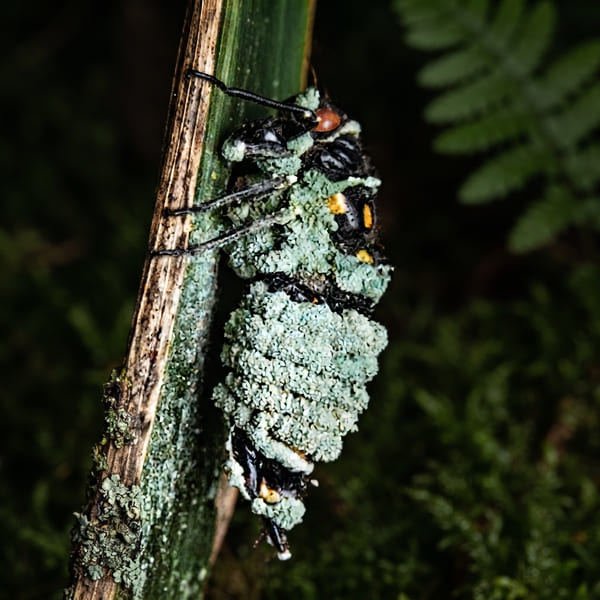
It is a fungus that lives naturally in soil all over the world and infects insects. Ilya Metchnikoff described it back in 1879, and gardeners sometimes call the disease it causes green muscardine, because a dead insect ends up coated in olive green spores.
The part I find most useful to understand is how it kills. An insect does not need to eat it. A spore lands on the pest, sticks to its skin, germinates, and dissolves its way through the cuticle with enzymes. Once inside, the fungus spreads through the body and releases compounds called destruxins that shut down the insect’s immune defenses. That is why contact matters so much, and why everything about application comes down to one goal: getting live spores onto the pest.
You may see two names on labels. Scientists reorganized the group using DNA, and the famous F52 strain, long sold as Metarhizium anisopliae, is now classified as Metarhizium brunneum. Same organism, new name.
What is Metarhizium

Does it do anything for the rose itself?

This is my favorite piece of the science. Metarhizium does not only wait in the soil for insects. It also colonizes plant roots, and in studies it stimulated the growth of root hairs.
Even better, researchers showed that it can carry nitrogen from the insects it has killed straight to plant roots, and the plant pays it back in carbon. Those experiments were done on beans, switchgrass, and barley, so I will not promise you bigger blooms. I like knowing that the pest that chewed my rose may end up feeding it.

Does Metarhizium work on thrips?

Yes, and thrips are the main reason I use it.
To see why, look at how thrips spend their lives. The larvae and adults hide inside buds and on leaves, which is where we see the scarred petals and brown edges. Then the mature larvae drop to the ground and pupate in the soil. Sprays aimed at the foliage never reach them down there.
Metarhizium does. Granular and liquid products based on strain F52 are registered specifically for thrips, including the pupae in soil. A root drench puts the fungus exactly where the next generation is waiting to hatch.
Don’t expect one drench to wipe them out, though. Thrips never go underground all at once. Some are pupating in the soil while the rest are still up in the buds, happily ruining petals. So I treat the soil in spring and again in fall, and I let my foliar spray deal with whatever is hiding in the flowers. Between the two, each new generation comes up a little thinner than the last.

What about whitefly, spider mites and aphids?
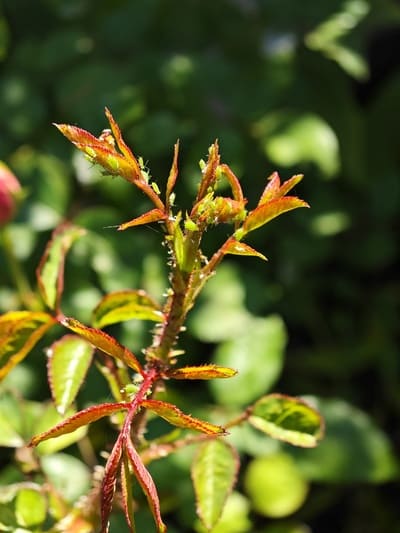
All three are on the label. Liquid F52 products are registered for whiteflies, thrips, mites and aphids, applied either as a foliar spray or as a drench.
For these pests, the spores have to land where the insects live. Whiteflies and spider mites sit on the underside of the leaf, so that is where the spray needs to go. Humidity helps a great deal. Spores need moisture to germinate on the insect, and in greenhouse trials with fungal sprays, thrips mortality passed 70 percent when relative humidity held around 80 percent.
feeding roses vs feeding soil

Will it help with rose sawfly, the rose slugs that skeletonize my leaves?

It will. In laboratory tests, Metarhizium anisopliae infected and killed rose sawfly larvae, and the higher the spore concentration, the fewer larvae survived to pupate.
The biology works in our favor here too. When rose slugs finish feeding, they crawl down and spin their cocoons in the soil under the bush. A drenched root zone is waiting for them.
On the leaves, I rely on Beauveria bassiana, a close cousin of Metarhizium. In lab trials, its best isolate killed up to 90 percent of rose sawfly larvae. So my approach is a pair: Beauveria above ground for the larvae that are feeding, Metarhizium below ground for the ones that come down to pupate.
Suppose your sawfly is the kind whose larva tunnels inside the cane, no spray or drench can touch it. Cut the wilted shoot below the damage.

Does it control anything else in a rose garden?

Root weevils, for one. In field strawberries, a high rate of Metarhizium controlled 71 to 96 percent of black vine weevil larvae, the same grubs that chew rose roots in pots and beds. The low rate managed only 6 to 11 percent, which tells you this is not a product to stretch thin.

How do I apply it?

I drench. I mix the product with water according to the label and pour the solution under each bush, over the whole root zone and a little beyond it, onto soil that is already moist. Dry soil is a poor home for a fungus, so in a dry spell, water the day before.
The detail people skip is the water itself. Use water without chlorine. These are living spores, and chlorine is added to tap water for the single purpose of killing microbes. Rainwater is ideal. If you only have tap water, let it stand in an open bucket for a day so the chlorine can escape. Some cities treat water with chloramine, which does not evaporate that way, and in that case rainwater or a carbon filter is the safer choice.
Mix only what you will use the same day. The label for F52 warns that spores held in water for more than 24 hours lose strength.

If you would like to try this pair in your own garden, here are products with the same active ingredients I work with: Metarhizium anisopliae for the soil and Beauveria bassiana for the leaves. These are affiliate links, so I may earn a small commission if you buy through them, at no extra cost to you.

Can I spray Metarhizium on the leaves?

You can. Foliar spraying is a registered use for whiteflies, thrips, mites, and aphids, so this is not a garden myth. It simply asks more of you than a drench does.
Sunlight is the enemy. In one study, eight hours of UV-B exposure left most Metarhizium isolates with germination below 5 percent. Soil protects spores from that. A leaf does not.
So if you spray, do it this way:
  • Spray in the evening or on an overcast day, never in midday sun.
  • Wet the undersides of the leaves, where whiteflies and mites feed.
  • Choose a humid evening if you can. Spores germinate on the insect only when there is enough moisture in the air.
  • Skip open blooms and spray after the bees have gone home.
In my own garden, Metarhizium goes into the soil and Beauveria goes on the leaves. That split has served my roses well, and it plays to the strength of each fungus.

When is the best time to apply, and how often?

In my own garden, Metarhizium goes down twice a year. The first drench comes in spring, once the soil has properly warmed. The second comes in fall, while the soil is still warm, around 61°F (16°C). In the heat of summer, I do not apply it at all.
There is good reason behind this timing. Metarhizium likes its soil warm and damp, the way it is in spring and again in early fall. Cold stops it: below about 43 to 46°F (6 to 8°C) the fungus simply does not grow. Heat stops it too, somewhere near 100°F (38°C), and strong summer sun kills the spores fast. Why waste good product on baked July soil? I would sooner wait for the mild weeks, when it can actually take hold.
Two drenches are enough because the fungus stays. In one field study, it was still present in soil more than 250 days after application. A spring treatment is waiting for the first generation of thrips and sawfly larvae that come down to pupate, and a fall treatment meets the ones that plan to spend the winter under your bushes.
Spraying the leaves is a different rhythm altogether. Spores sitting on a leaf don’t live long, so the F52 label tells you to come back every 5 to 10 days for as long as the pests are around.
And please, start before things get out of hand. I see gardeners reach for Metarhizium when the bush is already crawling, then give up on it a week later. It doesn’t work like that. An insect that picks up the spores takes 3 to 7 days to die, longer if the weather turns cool. This fungus is slow and stubborn, which is exactly why it belongs in your routine early in the season.

What can I combine it with?

Beneficial nematodes, first of all. Of everything Metarhizium has been paired with, this is the combination researchers have tested the most. When they put it in the soil together with a nematode called Steinernema kraussei, the two finished off black vine weevil larvae better than either one managed alone. In one trial, not a single larva survived. So if something is chewing on your rose roots, I’d use both.
Beauveria bassiana is the partner I use myself, in separate applications. Beauveria on the foliage, Metarhizium in the soil.
Trichoderma should not go into the same treatment. Trichoderma is a fungus that feeds on other fungi, and Metarhizium is one of the fungi it can attack. Both are welcome in my garden, only not in one watering can. Apply them a few days apart.
Fungicides, copper, and sulfur are where you must be strict. Metarhizium is a fungus, and fungicides do to it what they do to black spot. The F52 label says plainly not to apply fungicides near the time of treatment. My own rule after copper or sulfur is to wait 10 to 14 days before any living preparation goes back into the garden.

Garden tips

Unchlorinated water, moist soil, warm weather, evening hours, and patience. Give Metarhizium those five things, and it will quietly do its work under your roses all season.

Is it safe for bees, pets, earthworms, and me?

This is one of the reasons I trust it. When the US EPA reviewed strain F52, it concluded the fungus is practically nontoxic to mammals and does not harm lady beetles, green lacewings, parasitic wasps, honey bees, or earthworms. The European Food Safety Authority likewise found a low risk for mammals and for earthworms.
There is no waiting period before harvest either, which matters if herbs or vegetables grow near your roses.
Two habits I recommend anyway. Apply in the evening, when bees are not flying, and keep the spray off open flowers. And wear gloves and a simple mask while you mix, as you should with any product made of fine fungal spores.
  • Thrips. Metarhizium reaches the pupae in the soil. Drench the root zone in spring and again in fall.
  • Rose sawfly (rose slugs). It meets the larvae when they come down to pupate. Drench the root zone, and use Beauveria on the leaves.
  • Whitefly. Spray the underside of the leaves in the evening, every 5 to 10 days while they are active.
  • Spider mites. Spray the underside of the leaves in the evening, ideally in humid weather.
  • Aphids. Spray shoots and buds in the evening.
  • Root weevil grubs. Drench the root zone at the full label rate, with beneficial nematodes as a partner.
 

If You’re Trying to Figure Out What Your Plants Are Really Telling You

Thrips are only one of the reasons a rose refuses to bloom the way it should. Buds that brown at the edges, flowers that open crooked, bushes that sulk all summer: sometimes it is a pest, and just as often it is feeding, timing, or the spot the rose is planted in. I collected the causes I meet most often in Why Doesn’t My Rose Grow and Bloom? 100 Reasons and Solutions, so you can work out what is really going on before you reach for another bottle.

Living preparations like Metarhizium also ask you to remember things. When did I drench? How warm was the soil? Have two weeks passed since the copper? I can never keep all of that in my head, and I doubt you can either. That is what the Rose Garden Planner 2026: Log Book is for. Write it down once, and next spring you will know exactly what you did and whether it worked.

And if this article made you curious about the life in your soil, that curiosity is worth following. Fungi like Metarhizium are one small part of a much bigger underground community, and roses grown in living soil have far fewer problems to begin with. I wrote about how to build that kind of soil in an ordinary home garden in Revolution in the Rose Garden: Organic Rose Gardening.

Rose gardening books

Step into a calmer, more confident rose season. With Ann Devis’s rose gardening books and planner, you’ll get simple organic routines, proven tips, and checklists that keep your roses thriving – from first bud to last bloom.

FAQ

No. It infects insects, not plants. When it grows on and inside roots, researchers see no damage to the plant, and in studies the roots actually grew more root hairs.
They are relatives that work the same way, through contact with the insect’s skin. Metarhizium is first of all a soil dweller, and its range of target insects is narrower than Beauveria’s. That is why I think of Metarhizium as my soil fungus and Beauveria as my leaf fungus.
Adult beetles, yes. In recent European research, adult Japanese beetles were highly susceptible to Metarhizium, and spores sprayed on foliage survived more than three weeks in the field. The grubs in the lawn are a different story. They resist infection far better, so for grubs, nematodes are the stronger tool.
Yes. Strain F52 is registered for ticks on residential lawns, applied to the turf.
Products based on strain F52 are sold with an OMRI listing. Check for the OMRI seal on the specific product you buy.
Cool and out of the sun. The label warns that the spores are alive and that high storage temperatures harm them. A product that spent a summer in a hot garage may be nothing more than expensive dust.
Do not expect to find piles of dead insects. Infected pests die over several days, most of them out of sight in the soil. What you notice is fewer thrips in the next flush of blooms, and fewer rose slugs in the next generation.

Organic garden helpers

simple and effective

Leave a Comment

Sign In

Register

Reset Password

Please enter your username or email address, you will receive a link to create a new password via email.

Scroll to Top