
Let’s get your roses ready (step by step)
Picture us by the terrace with the last roses fading. You ask, “So… now what?” Here’s exactly what we’ll do.
Step 1 — Wind down growth (late summer → early fall)
- Stop all feeding 6–8 weeks before your first expected frost. Think: “Let the wood ripen.”
- Stop the deadheading; letting a few hips form tells the plant it’s time to sleep.
Step 2 — Wait for the cue (your first hard frost)
- When temperatures drop to 28°F / −2°C for several hours, leaves turn yellow and drop off. That’s true dormancy. Now we can’t tuck the plant in without forcing soft growth.
My favorite way (and why): heel in the whole pot
If you asked me to choose only one method for most gardens, I’d say: bury the pot.
Why I love it: It’s low-drama, inexpensive, and utilizes the ground as a giant thermal battery. When I heel in, I’m not fighting freeze–thaw or garage humidity. I just:
- Wait for dormancy.
- Dig a snug hole in a well-drained bed.
- Sink the entire pot to the rim.
- Mulch 6–8 in / 15–20 cm over the top and around the sides.
- Mark the spot. Water once to settle.
- After that, nature does most of the work. In spring, I lift, brush off, and we’re back in business.
A little real-life trick:
When a nursery ships late and frost has already arrived, I don’t panic or rush a poor planting. I heel in the rose right in its pot somewhere safe in the garden—rim level with the soil, a thick blanket of mulch on top—and forget about it until spring. When the ground thaws and I’ve picked the perfect spot (with the right light and companions), I simply pull up the pot and plant properly. No stress for me, no shock for the rose.
The other two methods I use
Cluster & insulate outdoors
Great in zones 7–8; possible in 5–6 if you have a truly sheltered nook.
- Pick a south/east wall out of the wind. Elevate pots on feet/strips so water drains.
- Snuggle pots together so they share warmth.
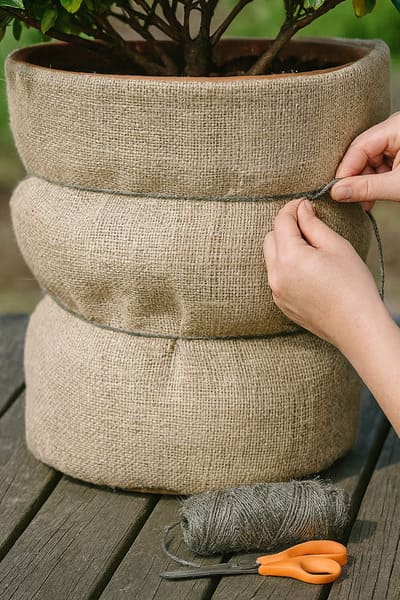
- Wrap the pot (not foliage) with burlap/frost cloth. If more insulation is needed, you may add a layer around the pot only (so soil can still breathe).
- Never shrink-wrap the plant itself—no plastic over canes or foliage.
- Mulch the soil surface to a depth of 4–6 inches / 10–15 cm.
- Give a good drink before deep cold; then check during thaws—if the pot feels light, water modestly.
- Tie in tall canes so wind doesn’t rock the rootball.
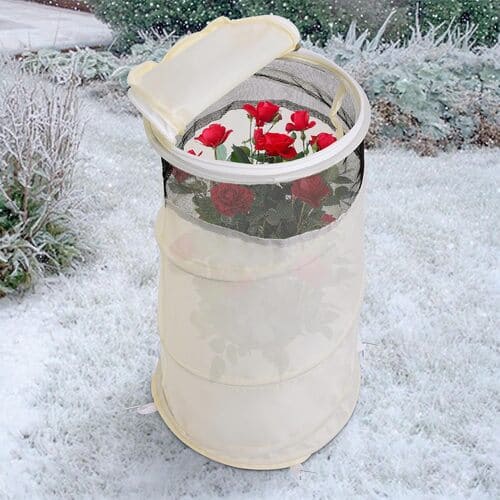
- Handy gear: winter cones for pots—they slip over the container, adding insulation without smothering the plant. I like these:
- Winter Protection Cones for Pots
Dormant cold storage (garage/shed/cellar at 34–45°F / 1–7°C)
My go-to for tree roses and tender varieties; simple and reliable in zones 3–6.
- Move after dormancy. Low light or dark is fine—we’re resting, not growing.
- Fall work = sanitation only (remove diseased leaves, dead tips).
- Water every 3–4 weeks—just enough to keep the ball from drying. No saucers that hold water.
- Ignore until late winter. That’s the joy.
Timing, I actually follow.
- 6–8 weeks pre-frost: stop feeding; let wood harden.
- First hard frost: leaves drop → now insulate, store, or heel in.
- Late winter to very early spring: Structural pruning once winter reveals what has survived.
Watering through winter (the “don’t skip this” bit)
- Outdoor setups: deep drink before the ground locks; afterwards, check during thaws and water lightly only if truly dry.
- Cold storage: perform a quick check every 3–4 weeks; add a small amount of liquid if the top few inches are dry. Keep soil barely moist, never wet.
My quick notes, you’ll thank me for later.
- Pot size matters. Bigger, thicker walls = happier roots. Plastic/wood/fiberstone outperforms terracotta in freeze–thaw cycles.
- Group therapy. Clustered pots lose less heat.
- Tree roses = divas. I store them cold at 34–40°F (1–4°C) whenever I can. Outdoors, only if I can wrap the stem/head and insulate the pot seriously.
- Set a phone ping for the moisture check. Future-you will forget. Ask me how I know.
- One more time: never wrap the plant itself in plastic. Breathable protection and pot-focused insulation only.
Fast Troubleshooting
- Wrinkly canes, green base: likely desiccation → rehydrate gently; tighten your moisture checks.
- Blackened tips downward: freeze injury → don’t rush; prune back to healthy pith in late winter.
- Mushy crown/roots: waterlogging → raise the pot, improve drainage, reduce watering frequency.
Key Takeaways
- Containers feel ~2 USDA zones colder than in-ground. Protect the rootball first.
- Wait for dormancy after a hard frost before wrapping or moving; otherwise, you will be babysitting soft growth all winter.
- Moist, not soggy. Winter losses in pots are often due to drying as much as to freezing.
- Select a method that suits your zone and storage requirements. Steady 34–45°F storage is gold in 3–6 weeks; protected clustering works in 6–8 weeks.
- Big pruning waits for late winter. Fall is for sanitation and calm.
- Safety note: Do not wrap the plant in plastic/poly; it traps humidity and can lead to rot and disease. If you wrap anything, wrap the pot only (breathable first; optional insulating layer outside).
FAQs from my inbox every November
Yes—if you treat roots like VIPs. In 7–8, clustering + insulation usually works. In 5–6, pick a super-sheltered corner or use cold storage/heel-in. Remember: pots often act as if they are two zones colder than in-ground.
Sustained soil temperatures below ~20–25°F (−6 to −4°C) can injure roots, especially in small or thin-walled pots.
After dormancy, and only if you can hold 34–45°F (1–7°C). Move early, and you’ll be babysitting active growth.
Wrap the pot with burlap/frost cloth; if you add insulation, keep it around the pot only. Do not wrap canes or foliage in plastic.
Before the deep cold, water well. Then, monthly checks; small drinks only when dry. In storage: every 3–4 weeks.
Just sanitation now. Big shaping waits for late winter.
You can, but I don’t recommend it. Most garden roses prefer dormancy; indoors, they become leggy and prone to mites.
For many of us, yes. Heeling in is stress-free and very effective in zones 4–6—and it’s my favorite.
Bigger, thicker. Plastic/wood/fiberstone resists cracking better than terracotta.
They’re most vulnerable. Cold storage wins. Outdoors only with serious insulation and staking.
No—stop feeding 6–8 weeks pre-frost; resume in spring with visible new growth.
South/east wall, out of wind, good drainage underneath; avoid roof drip and wind tunnels.
If this guide helped, you’ll love these books I wrote for fellow rose lovers:
Rose gardening books

Step into a calmer, more confident rose season. With Ann Devis’s rose gardening books and planner, you’ll get simple organic routines, proven tips, and checklists that keep your roses thriving – from first bud to last bloom.