
Someone in my Facebook group posted a photo last week: a rose bush with a fat ring of wet coffee grounds heaped against the stem. The caption said “giving my girls a treat.” Plenty of people liked it. I hesitated before I replied, because the honest answer to whether coffee grounds are good for roses isn’t the clean yes she was after. Whether the grounds are fresh or composted changes the whole story, and hardly anyone mentions that part.
I’ve been putting coffee grounds on my own roses for years, and I’m not about to stop. I just don’t do it the way most articles tell you to. Here’s what really happens when the grounds hit your soil, and the one method that actually helps.
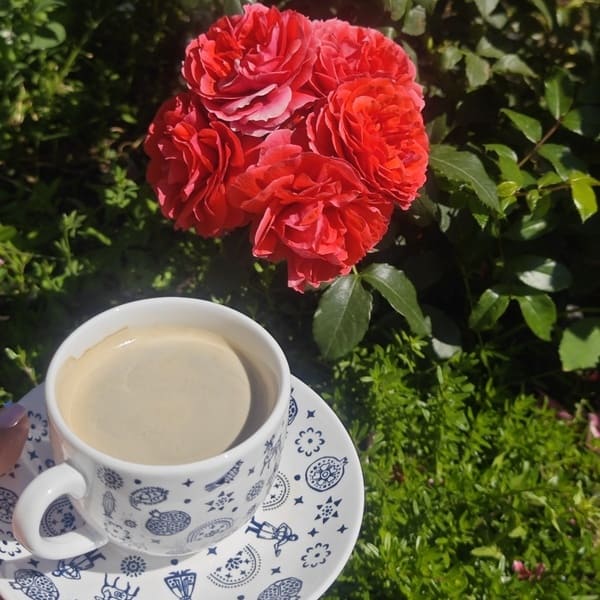
The myth that won't die: "coffee grounds make soil acidic, and roses love acid"
This is the one I hear most, and it’s wrong on both halves.
Start with the coffee. The grounds left in your filter after brewing are not the acidic thing you drank. Most of the acids are water-soluble, so they end up in your cup, not in the bin. What’s left over sits close to neutral university testing puts used, brewed grounds at around pH 6.5 to 6.8. That’s roughly where you want your rose soil to be anyway. So the idea that you can toss grounds around your bushes and meaningfully acidify the soil? It doesn’t hold. If your soil is alkaline and your leaves are going yellow between the veins, coffee grounds will not fix that. (For that particular problem, see my guide on why rose leaves turn yellow — it’s almost never a coffee-shaped hole in your routine.)
And the second half that roses crave acid soil? Roses are perfectly happy in slightly acidic to neutral ground. They are not blueberries. Chasing acidity you don’t need is how people accidentally lock up nutrients and create the exact deficiencies they were trying to prevent.
So that’s myth number one, gone.
Here’s where it gets uncomfortable: fresh grounds can hurt your roses
This is the part the “free fertilizer!” crowd leaves out.
When you dump fresh spent grounds straight onto soil, two things happen, and neither is doing your rose any favors in the short term.
First, the nitrogen problem. Yes, coffee grounds contain nitrogen — roughly 1 to 2 percent by weight. But it’s locked inside organic matter that soil microbes have to break down first. And to do that breakdown, those microbes pull available nitrogen out of the soil to fuel themselves. For a while, they’re competing with your rose’s roots for the very nutrient your rose needs most in summer. Gardeners see the result and blame everything but the grounds: paler leaves, a sulky bush, growth that just… stalls.
Second, and this surprised me when I first read the research, there’s the caffeine and the plant compounds still hanging around in the grounds. Researchers at the University of Melbourne mixed spent coffee grounds into soil and grew broccoli, leek, radish, violas and sunflowers in it. Across the board, in every soil type, with and without added fertilizer, the plants grew worse. Even small amounts had a measurably negative effect. Coffee contains compounds that suppress the growth of other plants; that’s not a bug, it’s how the coffee plant fends off competition in the wild. Those compounds don’t magically vanish because the beans went through your machine.
I’ll be honest: I don’t have a controlled trial on my own roses, and I’m not going to pretend I do. But I did once mulch a young ‘Eden’ with a thick layer of straight grounds, feeling very clever and thrifty about it. It sulked for the better part of a month while its neighbor, same age, same bed, romped ahead. I don’t do that anymore.
And the mulch trap nobody warns you about
There’s a physical problem on top of the chemical one. Coffee grounds are tiny and uniform, and when you spread them in a layer they knit together into a crust. That crust sheds water instead of letting it through, and it seals air out of the soil below. For a rose — a plant that wants deep, even moisture and living, breathing soil — a felted mat of coffee grounds sitting on the surface is the opposite of helpful, especially in a hot July when you need every drop to reach the roots.
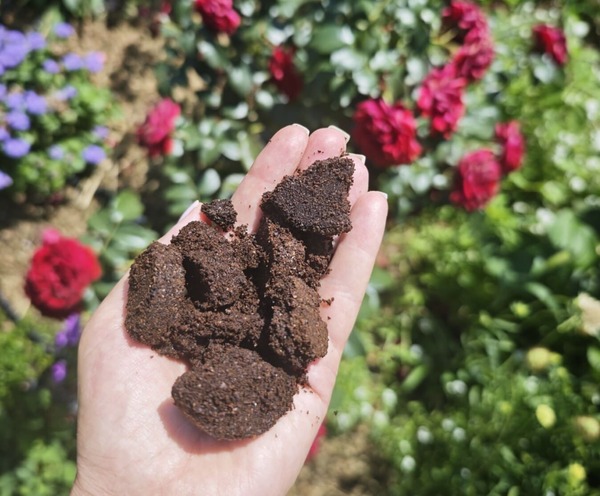
So how do you use them? Compost first always
Here’s the good news, and the reason I still save my grounds.
Composted coffee grounds are a genuinely different material from fresh ones. Once they’ve broken down with browns and greens, the nitrogen tie-up is over, the caffeine has largely degraded, and what you’re left with is a lovely dark crumb that feeds soil life beautifully. There’s even research suggesting composted grounds help suppress some fungal troublemakers — Fusarium, Pythium, Sclerotinia — which, for those of us fighting black spot and other rose diseases without chemicals, is a quietly exciting bonus. (It’s one more small piece of the living-soil approach I build my whole method around — more on that in my organic rose feeding schedule.)
The rules are simple and worth respecting:
Keep coffee grounds to no more than 20 percent of your compost pile by volume. Push past 30 percent, and the research shows it starts working against you again. Mix them with plenty of “browns”: dry leaves, shredded cardboard, at roughly three parts leaves to one part grounds. Turn it. Give it three to six months. Then it goes into the beds, worked lightly into the top few inches, not piled against the crown.
That’s it. That’s the whole trick. The grounds were never the problem. Timing was.
What I actually do in my garden
I keep an old metal bucket by the back door. Coffee grounds go in, along with the tea leaves and the vegetable ends, and once a week that bucket gets emptied onto the compost heap and covered with a fistful of dry leaves. Months later, that compost grounds and all gets spread as a thin feeding mulch under the roses in spring, then topped with coarser bark so it doesn’t crust over.
Do the roses notice? The soil does, and the roses live in the soil, so — yes, eventually, in the way good soil always shows up in a plant: steadier growth, better color, fewer sulks. It’s not a magic bullet. There’s no magic bullet. There’s just soil that’s alive, fed patiently, over seasons. That’s the entire philosophy, and coffee grounds are one very small, very free ingredient in it.
The honest bottom line
Are coffee grounds good for roses? Composted and used with a light hand, yes — they’re a small, free contribution to living soil. Fresh, piled straight onto the bed as “fertilizer,” no — you’re risking a nitrogen dip, a caffeine check on growth, and a water-shedding crust, all at once. And as an acid treatment for your soil, forget it entirely; that’s a myth that got repeated so often it started to sound like fact.
Save your grounds. Just send them to the compost heap first, not the rose bed.
If You’re Trying to Figure Out What Your Plants Are Really Telling You
If you want the full picture of how I build soil that grows disease-resistant roses without a single chemical — the microbes, the mulch, the feeding rhythm, all of it — that’s exactly what my book covers: Revolution in the Rose Garden — Organic Rose Gardening: Building Living Soil, Preventing Disease Naturally, and Growing Strong, Beautiful Roses Without Chemicals. And if your roses are growing but stubbornly won’t bloom, I wrote a whole troubleshooting guide for that too: Why Doesn’t My Rose Grow and Bloom? 100 Reasons and Solutions.
Rose gardening books

Step into a calmer, more confident rose season. With Ann Devis’s rose gardening books and planner, you’ll get simple organic routines, proven tips, and checklists that keep your roses thriving – from first bud to last bloom.
FAQ
No. Used, brewed coffee grounds sit near neutral, around pH 6.5 to 6.8, because most of the acid dissolves into your cup during brewing. They won’t meaningfully lower your soil pH, and roses don’t need acidic soil anyway — slightly acidic to neutral suits them fine.
It’s best not to. Fresh grounds can temporarily tie up soil nitrogen as microbes break them down, and leftover caffeine and plant compounds can slow growth. They also compact into a water-repellent crust. Compost them first, then use the finished compost.
Keep them to no more than about 20 percent of the pile by volume, mixed with plenty of dry “browns” like leaves. More than 30 percent has been shown to work against you. Give the pile three to six months to fully break down.
There’s evidence that strong caffeine solutions deter and even kill slugs and snails, but that’s a concentrated spray, not a scatter of grounds. As a casual mulch, don’t count on grounds for pest control lean on healthy soil and beneficial insects instead.
No. At 1 to 2 percent nitrogen locked in slow-release form, grounds are a soil conditioner, not a fertilizer. Think of them as one ingredient in your compost, part of a complete organic feeding plan not a standalone meal for a hungry rose.
It’s best used as a foliar spray only. Applying it to soil repeatedly can cause calcium buildup and interfere with other nutrient uptake.


