
Roses are often called the “queens of the garden,” and like any queen, they can be a little dramatic when something’s wrong. One day your bushes are covered in glossy green leaves, and a few weeks later you’re staring at ugly black blotches wondering what you did wrong.
I’ve grown 150 rose bushes organically for years, and black spot is the disease I get asked about more than any other. The good news: it’s completely manageable. The bad news: most of the advice floating around online treats it like a one-spray problem, when it’s really a system problem. In this guide, I’ll walk you through what black spot actually is, the home remedies that genuinely help (and their limits), and the organic protocol I use in my own garden to keep it under control season after season.
What Is Black Spot, Exactly?
Black spot isn’t a virus or a bacteria — it’s a fungal disease called Diplocarpon rosae. It shows up as irregular black or purplish spots on the upper side of the leaf, and as the infection progresses, the tissue around each spot turns yellow before the whole leaf drops.
The fungus survives winter on fallen leaves and infected canes, then splashes back onto new growth every time it rains, or you water overhead. That’s the key thing to understand: black spot is a splash-spread disease. Every strategy that works — from sanitation to biologicals — works because it interrupts that splash cycle in some way.
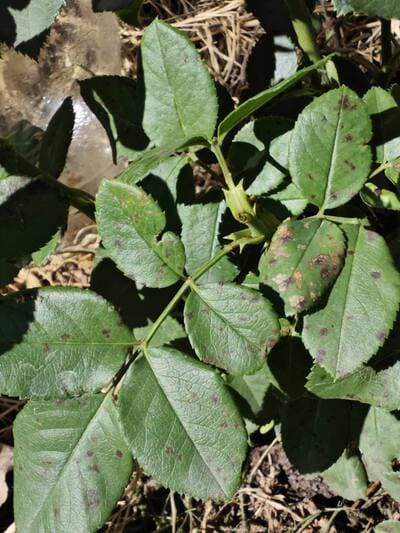
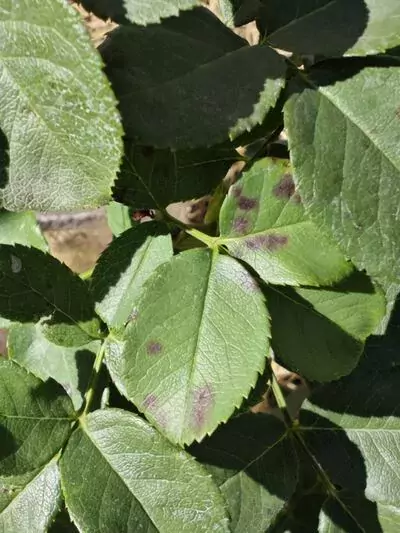
Why It’s More Than Cosmetic
A few spots on a couple of leaves won’t hurt your rose. But left unchecked, black spot causes real damage:
- Defoliation — infected leaves yellow and drop, robbing the plant of the leaf area it needs to photosynthesize
- Reduced blooming — fewer flowers, and smaller ones, on a plant that’s lost leaves
- Weakened plants — repeated seasons of defoliation make roses more vulnerable to winter injury and other diseases.
- Spread — spores travel on wind and splashing water, so one infected bush can seed an entire bed.
Here’s the reassuring part: black spot very rarely kills a rose outright. It weakens the plant and drags down its performance, but with a consistent protocol, even a badly infected bush will recover.
My Organic Black Spot Protocol
This is the part most articles skip, and it’s the part that actually changes outcomes. Here’s exactly what I do, in the order I do it.
Step 1: Sanitation First — Always
No spray, organic or chemical, will outperform good sanitation. Before you treat anything:
- Remove and destroy infected leaves the moment you spot them — don’t compost them near your roses.
- Keep the centers of your bushes open with regular pruning so air can move through and dry the foliage.
- Rake up and dispose of fallen leaves in autumn, since this is where the fungus overwinters
- Water at the base of the plant in the morning, so leaves dry quickly if they do get wet.
Step 2: Biological Defense
Once the black spot is active, I rely on two biological tools, used on a rotation rather than mixed together:
Bacillus subtilis is my main leaf defender. It colonizes the leaf surface and competes directly with the black spot fungus for space and resources, thereby slowing new infections.
Chitosan is the second piece. Rather than attacking the fungus directly, it triggers the rose’s own immune response (technically called induced systemic resistance), so the plant defends itself more effectively against future infection. I use a chitosan product in my own garden; if you’re gardening in the US, you can find chitosan-based sprays formulated for exactly this purpose — 👉 Chitosan.
The one rule that matters here: never apply these on the same day. Chitosan is acidic, and that acidity reduces how well Bacillus subtilis performs. Space them 3–4 days apart, and you get the full benefit of both.
Step 3: Escalating When It’s Severe
If an outbreak is getting ahead of you, it’s reasonable to step up to a mineral fungicide — sulfur or copper. Two rules keep this from backfiring:
- Never mix sulfur and copper. Choose one, not both, in a single application.
- Wait 10–14 days after a mineral spray before using any biological product again. Mineral fungicides are hard on the same beneficial microbes you’re trying to build up, so give them time to recover before you reapply Bacillus or chitosan.
Step 4: The Piece Almost Nobody Talks About — Soil Balance
Here’s something I learned the hard way in my own garden. Even with a full biological spray program, I was still getting hit hard by black spot some seasons. The issue wasn’t my spray schedule — it was my soil. My amendment routine (aged manure, vermicompost, EM preparations) was leaning heavily bacterial, and that imbalance was quietly making my roses more susceptible to fungal disease in the first place.
If you’re doing everything “right” above the soil line and still struggling, look at what you’re feeding your soil. Adding fungal-friendly inputs — sea kelp, fish meal, humic acid — helps rebalance things so your roses are naturally more resilient, not just defended from the outside.
A Note on Weather
Some seasons will hit you harder no matter what you do. A cold, wet spring with wind and hail creates ideal conditions for black spot even in a well-managed garden. If you get a bad outbreak in a rough season, that’s not your protocol failing — it’s weather. Stay consistent, and your roses will recover.
Home Remedies for Black Spot — What Actually Helps
These home remedies are popular, and some of them genuinely help as a supportive, preventive layer alongside the protocol above. None of them will cure an established infection on their own — treat them as one tool, not the whole toolbox.
1.Whey and Water Spray
Ingredients: 1 part whey, 5 parts water
How to use it: Combine and shake well. Spray the tops and undersides of leaves late afternoon to avoid leaf burn. Remove diseased leaves and debris first. Apply weekly or every other week, ideally before spots appear.
Note: This is a preventive measure, not a cure for existing infection.
2. Baking Soda Solution
Ingredients: 1 heaping tablespoon baking soda, 1 gallon water, optional splash of horticultural oil or soap for adherence
How to use it: Mix and test on a few leaves first, waiting a few days before spraying your whole bush. Apply to both sides of the leaves.
Note: Baking soda is alkaline — don’t overuse it, or you risk leaf damage.
3. Lime Sulfur Spray
Ingredients: Lime sulfur, diluted per the manufacturer’s instructions
How to use it: Apply during winter dormancy, spraying the stems and trunk to knock back overwintering spores before spring growth begins.
4. Milk and Baking Soda Combo
Ingredients: ½ liter milk, 2 tablespoons baking soda, 5 liters water
How to use it: Mix thoroughly and spray liberally over foliage and stems. Can be used any time of year. Test on a small area first.
Prevention: The Best Long-Term Strategy
- Choose resistant varieties — shrub roses and many floribundas tend to tolerate black spot far better than hybrid teas; ask your local nursery which varieties perform well in your climate.
- Inspect regularly — catching an early spot is far easier than fighting a full outbreak.
- Prune for airflow — an open center dries faster after rain or watering.
- Keep it clean — fallen leaves and debris are where the disease waits out the winter.
Ready to Build a Rose Garden That Doesn’t Fight You Every Season?
Everything in this article — the protocol, the timing rules, the soil insight — comes straight out of what I’ve tested on my own 150 rose bushes. If you want the full system, not just the black spot piece, my books walk you through it end to end: building living soil, reading what your roses are telling you, and putting together a season-long organic care calendar so you’re not improvising every time a new problem shows up.
Start with Why doesn’t my rose grow and bloom if you’re ready to go organic from the ground up, or Revolution in the Rose Garden if blooming problems (black spot included) are what’s frustrating you right now. And if you’d rather have a simple companion to track what you’re doing and when, the Rose Garden Planner keeps your whole season organized in one place.
Rose gardening books


Step into a calmer, more confident rose season. With Ann Devis’s rose gardening books and planner, you’ll get simple organic routines, proven tips, and checklists that keep your roses thriving – from first bud to last bloom.

FAQs:
Yes, if spores overwinter on fallen leaves or infected canes. Clean up debris every fall, and you’ll start spring with far less pressure.
Yes. Black spot weakens roses but rarely kills them outright. Remove infected leaves, start the protocol above, and the plant will recover.
It’s rose-specific, but it spreads rose to rose fast through wind and splashing water — treat your whole bed, not just the one bush you noticed first.
Yes — shrub roses and many floribundas tend to shrug it off better than hybrid teas. Resistance does shift over time as local fungal strains change, so good practices still matter even with a “resistant” variety.
I treat every 7–10 days once black spot shows up, and always right after a heavy rain, since that’s when spores splash onto clean leaves.
A diluted vinegar spray (1 part vinegar to 10 parts water) can offer mild preventive benefit, but treat it the same way as the other home remedies above — supportive, not curative.
The fungus is far less active in cold weather, but it survives dormant on canes and fallen leaves. A winter lime sulfur application is a smart way to reduce spring pressure.


