

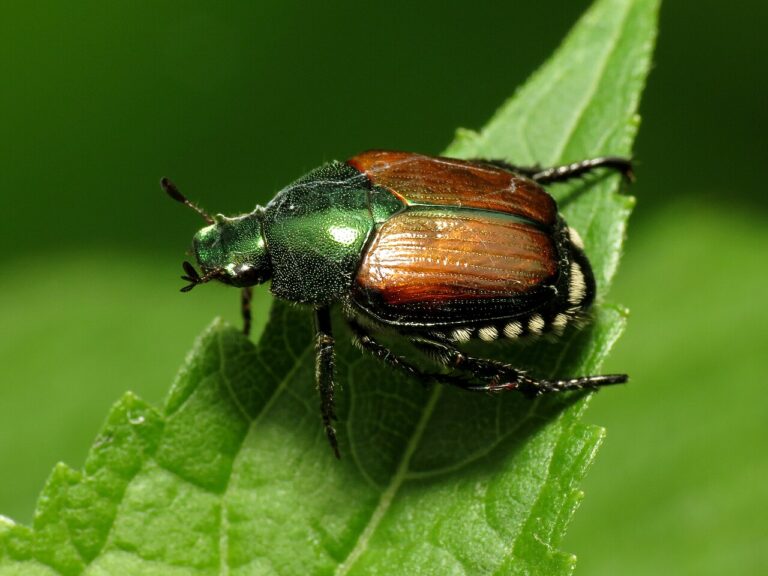
If you grow roses, you already know the feeling: one morning your blooms are perfect, and by the next afternoon they look like lace, ragged holes everywhere, with metallic green-and-copper beetles mating right on the petals like they own the place. Japanese beetles are one of the most frustrating rose pests in North America, and a lot of the advice circulating online actually makes the problem worse instead of better.
I’ve been growing roses organically for years, testing what genuinely works in my own garden rather than repeating whatever gets shared around. This guide walks through a complete, science-based, chemical-free strategy — timed to the beetle’s actual life cycle, not just “spray when you see them.”
Know Your Enemy: The Japanese Beetle Life Cycle
nderstanding the beetle’s yearly cycle is the key to everything else in this guide, because it explains why timing matters so much more than the product you choose.
Adult beetles emerge from the soil in late spring to early summer (roughly June, depending on your climate zone) and feed for about six to eight weeks, mating and laying eggs in lawns and garden beds as they go. Those eggs hatch into grubs by late summer. The young grubs feed close to the soil surface on grass and root material through fall. As the soil cools, they burrow down below the frost line to spend winter in a dormant state. Then, as the soil warms again in spring, they migrate back up toward the surface to resume feeding for a few weeks before pupating and emerging as adult beetles and the cycle starts over.
That upward-then-downward migration is exactly why the soil treatments later in this guide are applied at specific times of year rather than whenever you happen to think of it.
Why Japanese Beetles Target Roses Specifically
Japanese beetles are drawn to a combination of scent and color — they’re especially attracted to light-colored and fragrant blooms — and rose petals are thin and tender enough that they’re easy to skeletonize quickly. On top of that, moist, well-irrigated soil around rose beds (exactly the kind of soil healthy roses need) happens to be ideal egg-laying habitat, which is part of why beetle pressure often seems worst right where your roses are thriving.
The Big Mistake: Pheromone Traps
Beetle traps look like an obvious solution, and garden centers sell a lot of them. The problem is in how they work: they use a strong floral and pheromone lure to draw beetles in from a wide radius — sometimes hundreds of yards. If that trap is sitting in or near your garden, you are actively advertising a free meal to every beetle in the neighborhood, and only a fraction of the beetles that show up actually end up in the bag.
Extension entomologists have reached the same conclusion: in areas where Japanese beetles are already established, traps are not considered an effective control method, and gardens with a trap nearby can end up with more feeding damage than gardens without one. If you want to use a trap, place it as far from your roses as your property allows — never next to the plants you’re trying to protect.
Hand-Picking: Unglamorous, But It Still Works Best
The single most effective organic control — and the one I rely on most — is simply removing beetles by hand. It costs nothing, it doesn’t harm anything else in the garden, and it works immediately.
- Go out early in the morning, while the air is still cool. Beetles are sluggish in cool temperatures and can’t fly away quickly.
- Hold a container of soapy water underneath the beetle (a few drops of dish soap break the surface tension so they can’t climb out or fly off once they’re in).
- Tap the flower or leaf, or just nudge the beetle. Startled beetles instinctively drop rather than fly, so they fall straight into the container.
- Five to ten minutes a day during peak season (roughly June through August) makes a real, visible difference within a week or two.
There’s also a biological reason this works better than it sounds like it should: feeding beetles release aggregation pheromones that call in more beetles, and damaged foliage releases its own volatile signals that attract them from further away. Removing beetles promptly doesn’t just eliminate those individuals — it reduces the chemical “dinner bell” that would otherwise pull in reinforcements.
Winning the War Underground: A Two-Step Grub Strategy
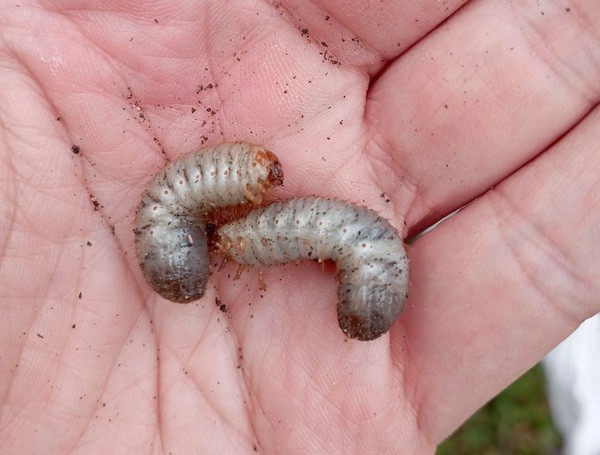
Because Japanese beetles spend roughly ten months of the year underground as grubs, the soil is where long-term control actually happens. This isn’t a quick fix — it’s a strategy that compounds over a few seasons — but it’s the difference between fighting the same battle every June and gradually having fewer beetles to deal with at all.
Step One: Beneficial Nematodes, Applied in Late Summer
Beneficial nematodes — specifically Heterorhabditis bacteriophora — are microscopic roundworms that actively hunt through the soil, enter grubs through natural body openings, and release bacteria that kill the host within a couple of days. Apply them to moist soil in late summer, shortly after eggs have hatched, when grubs are still small, thin-skinned, and close to the surface — this is the point in their life cycle when they’re most vulnerable.
A few practical details matter more than the product label usually explains: water the soil before application so nematodes can move freely, apply in the evening or on an overcast day (direct UV kills them quickly), and keep the treated area consistently moist for about two weeks afterward so the nematodes can establish. Soil temperature should be reliably above 60°F; below that, nematodes go dormant and simply won’t find their targets.
Step Two: Metarhizium, Applied in Spring and Late Fall
Metarhizium is a beneficial soil fungus that controls grubs in a completely different way than nematodes do. Its spores attach to a grub’s outer cuticle, germinate, and grow directly through the body wall into the insect, eventually killing it from the inside.
I apply it in spring and again in late fall — the two windows when grubs are migrating through the soil profile rather than sitting still. In fall, as the soil cools, grubs move down toward the frost line to overwinter; in spring, as it warms, they move back up to resume feeding before pupating. That movement matters because it brings grubs into contact with fungal spores in the topsoil — a grub actively traveling through treated soil has far more exposure than one that’s dormant several inches down or already gone. Soil temperature matters too: Metarhizium spores germinate and infect best in moderate conditions, roughly the same range most garden soil sits at during spring and fall, whereas deep winter cold and high summer heat both suppress fungal activity.
Used together, nematodes and Metarhizium cover the grubs at two different, non-overlapping points in their yearly cycle, a more resilient strategy than relying on either alone.
The Long Game – Preventative Measures
Winning the battle against beetles is one thing, but maintaining a beetle-free garden is another. Prevention became my focus. Regularly inspecting my rose bushes, maintaining healthy soil, and attracting natural predators like birds and beneficial insects created a robust defense system.
Rose gardening books


Step into a calmer, more confident rose season. With Ann Devis’s rose gardening books and planner, you’ll get simple organic routines, proven tips, and checklists that keep your roses thriving – from first bud to last bloom.

What About Milky Spore?
Milky spore disease (Paenibacillus popilliae) is the older, more familiar option, and some gardeners still swear by it. It’s worth knowing its limitations going in: it targets Japanese beetle grubs specifically and nothing else, and it can take two to four years of buildup in the soil before it reaches effective levels — which is a long time to wait if beetles are actively shredding your roses right now. That’s the main reason more organic growers, myself included, have shifted toward the faster-acting nematode-and-Metarhizium combination instead.
Kaolin Clay: A Physical Barrier Beetles Hate
Kaolin clay, sprayed on leaves and buds, dries into a fine, chalky film that coats the surface of the plant. Beetles don’t like landing or feeding on it — it interferes with their ability to grip and recognize the plant as food — so treated roses see noticeably less feeding damage. It washes off in rain and needs reapplying, but it’s inert and completely safe for bees, beneficial insects, and the soil, which makes it one of the lowest-risk tools in this whole guide.
Feed the Plant: Nutrition as Pest Defense
This part gets skipped in most beetle guides, but it matters. A rose that’s genuinely well-nourished — not just watered and mulched, but supplied with the minerals it needs and supported by healthy soil biology — builds tougher cell walls and produces compounds that make its tissue less attractive and less digestible to pests. This is essentially what agronomist John Kempf means when he talks about plant immunity through nutrition: it isn’t a mystical idea; it’s plant physiology. Silica strengthens cell walls, calcium supports structural integrity, and a diverse soil microbial community helps the plant access and use both. None of this replaces the other methods here, but a well-fed rose simply gives beetles less reason to stay.
Garden Housekeeping and Companion Planting
Clear away rotting wood, fallen fruit, and decaying plant debris near your roses — the fermenting odors from overripe fruit and dying vegetation are genuinely attractive to adult beetles, so removing them removes part of the invitation. Some gardeners also plant garlic, chives, or catnip near roses on the theory that their strong scent masks the rose’s own attractive smell. The evidence for this is more anecdotal than proven, but it’s low-risk, low-cost, and a pleasant enough addition to a bed that it’s worth trying alongside the methods above — just don’t rely on it as your main line of defense.
What to Skip Entirely
- Pheromone beetle traps near your garden they draw in more beetles than they catch.
- Broad-spectrum pesticides: they kill ground beetles, parasitic wasps, and other natural predators along with the Japanese beetles, which tends to make populations worse the following season.
- Neem oil (or any oil-based spray) applied in direct sun or high heat — it stops working and can burn the foliage.
Your Beetle-Season Calendar at a Glance
- Early spring: Apply Metarhizium to soil around rose beds as overwintering grubs migrate upward.
- Late spring, before beetles emerge: Apply kaolin clay proactively; review your soil and nutrition program.
- Early summer, as adults emerge: Begin daily morning hand-picking; start evening neem applications as needed.
- Peak summer: Continue hand-picking and evening neem; apply beneficial nematodes once eggs have hatched and clear fallen debris regularly.
- Late fall: Apply Metarhizium again as grubs migrate back down to overwinter.
Frequently Asked Questions
Not for control, no. They’re effective at catching beetles, but they attract far more than they trap, so a trap near your garden usually increases the beetle pressure on your plants rather than reducing it. If you use one at all, put it well away from the roses.
Established roses almost always survive a beetle season, even a bad one — the damage is disfiguring but rarely fatal. Repeated, severe defoliation over several consecutive years can weaken a bush and make it more vulnerable to other stress, which is exactly why the underground, long-term grub control matters as much as what you do to the beetles you can see.
Adult beetles are typically active for six to eight weeks, usually sometime between June and August depending on your climate, with the worst pressure in the first few weeks after emergence. Outside that window, you’re dealing with grubs in the soil rather than adults on your plants — which is a different, quieter problem.
Not necessarily. Several different beetle species produce white, C-shaped grubs in lawn soil — June beetles and chafers among them — and they look almost identical to the untrained eye. Japanese beetle grubs can usually be told apart by the pattern of hairs on their rear end (a raster pattern in a distinct V shape), but for practical purposes, the nematode and Metarhizium strategy in this guide controls grubs broadly, not just this one species.
It can work, but it’s slow — often two to four years to build up to effective levels in soil — and it only targets this one species. If you want faster, broader results, the combination of beneficial nematodes and Metarhizium described above is the more practical choice for most gardens today.
A direct spray of soapy water can kill beetles on contact if you catch them directly, but it has no residual effect and won’t stop new beetles from arriving. It’s a reasonable backup for a bloom you can’t get to during your morning hand-picking round, not a replacement for it.
Grubs don’t respect bed borders — they’re just as happy under turf as under mulch — so treating only the soil directly around your roses leaves a large reservoir of grubs nearby that will keep producing adult beetles. Where practical, treating the surrounding lawn area gives the nematode and Metarhizium program a much better chance of actually reducing your local beetle population over time.
Japanese beetles are a genuinely difficult pest, and no single product or trick makes them disappear overnight. But a garden that combines morning hand-picking, correctly timed soil treatments, evening neem, kaolin clay, and a well-nourished plant underneath it all will have measurably fewer beetles — and measurably less damage — by the second or third season. That’s been true in my own garden, and it’s the approach I come back to every year.
Recent Posts
Organic rose gardener and author.
I share practical, soil-first methods tested in my own garden to help roses grow strong, healthy, and bloom naturally without chemicals.
Ann Devis