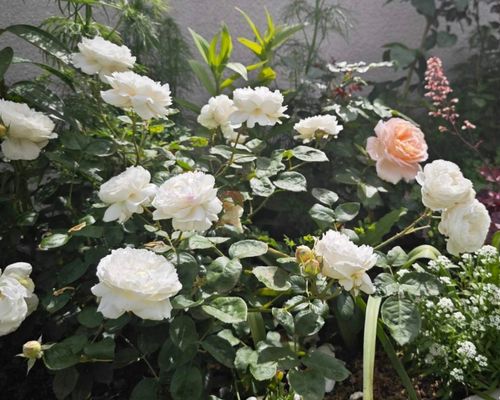
Ever notice how nobody prunes the trees in a forest? Nobody fertilizes them, nobody sprays for bugs, and there’s no army of gardeners out there weeding and worrying, and yet everything grows in thick, tangled, ridiculous abundance. Nature handles it.
I’ve thought about that a lot since the day I crouched down in a forest outside Tbilisi and dug my fingers into the floor. Under a loose blanket of old leaves and twigs and half-rotted blossoms was soil so soft and cool it felt like a different substance entirely dark, faintly sweet-smelling, alive in a way I could feel before I could explain it. That handful of dirt did more to change how I garden than any book I’d read up to that point. Including, eventually, the one I wrote.
A rose growing wild is never really alone. Its roots run through fungal threads, old leaves rot back into the ground right under it, beetles and birds pass through, and there are more microbes down there than I could ever count; none of it works in isolation. Notice that, and the same rules turn out to apply to a rose bed by your fence, not just to an actual forest.
You don’t need to let your roses run wild to benefit from this. You need to borrow the principles that keep forest soil alive, put decaying matter to work instead of raking it away, and let a bit of that self-managing chaos back into your beds. Here’s what that actually looks like, bed by bed.

Lesson one: bare soil is a wound, not a blank canvas
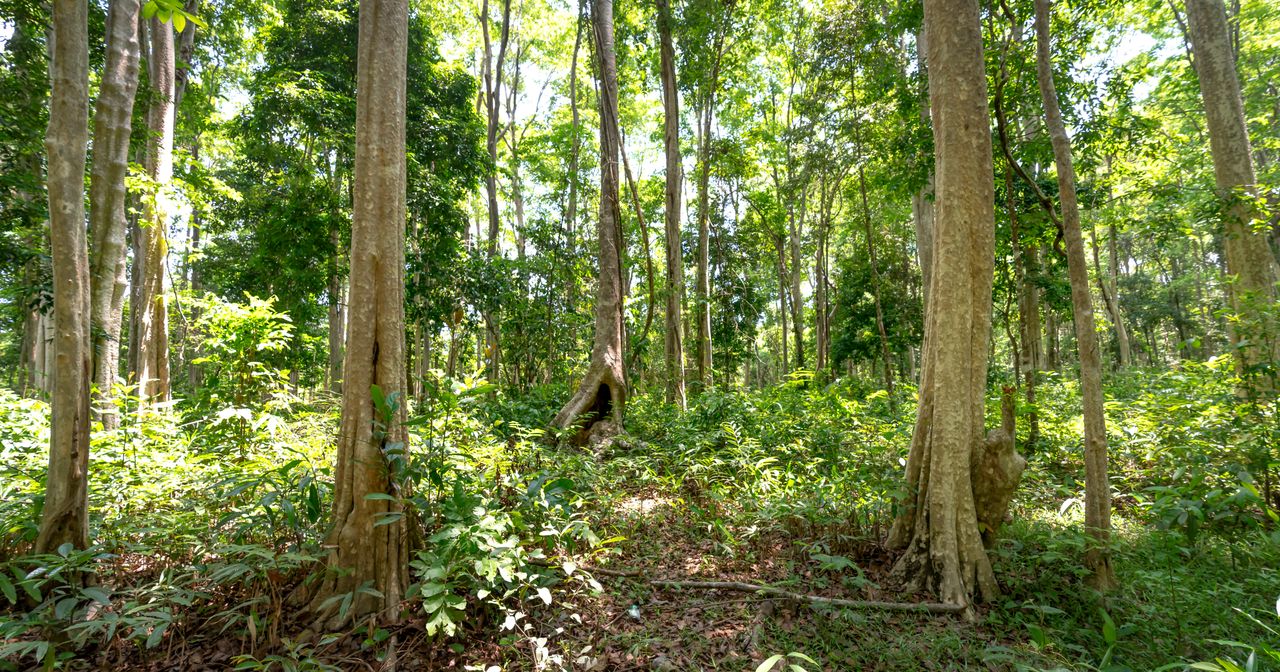
Forest floor is rarely exposed. It’s covered — leaves, moss, fallen bark, a slow-moving carpet of things dying and becoming soil again. Naked dirt is rare out there, and when you do find a patch of it, something has usually gone wrong.
For roses, this isn’t just an aesthetic preference. Bare soil around the base of a bush is one of the main reasons fungal spores — black spot chief among them make the jump from the ground onto your lowest leaves so easily during rain or overhead watering. The spores sit right there in the soil and splashed-up debris; all they need is a wet leaf close enough to land on. Every rose-care guide I’ve ever written eventually circles back to one unglamorous rule: keep a 10 to 15 cm gap between soil and the lowest foliage, because ground contact is a bridge for both black spot and rose sawfly. Mulch is what makes that gap mean something. Without it, rain resplashes the same bare dirt back onto the plant every time it falls.
Mulch under a rose isn’t decoration. It’s a physical barrier between the spores in the soil and the foliage above, and it does three or four other jobs at the same time: it holds moisture like a sponge, keeps root temperatures steadier through a brutal July, and feeds the very microbes doing the real disease-suppression work underground.
What actually goes into mine: grass clippings from my clover lawn, pre-wilted a day so they don’t mat down and rot; they’re soft, nitrogen-rich, and break down fast. Nettle and comfrey when I’ve got extra of either. Shredded leaves and old prunings to soak up some of that green nitrogen with a bit of carbon. And whatever aged compost I have sitting around, which works as mulch and a light feed at the same time. I keep the whole layer around 5 to 7 cm deep — go thicker, and you get a soggy, airless mat that’s worse for the roots than the bare soil ever was. And I always leave a clear ring around the base, nothing touching the stems.

What I’ve learned to watch for instead of a calendar is simpler than it sounds: my mulch disappears. If it’s visibly thinning out every few weeks, I don’t rush to top it up; that’s actually the good sign. Something down there is eating it, turning it into the same dark, crumbly stuff you’d find under real forest litter. So I only add more once it’s genuinely gone, because how fast it disappears tells me more about that soil than any test kit could. If a layer just sits there for months, stays bone-dry underneath, or starts smelling off, that’s when I get concerned about the soil, not the mulch, because that usually means the biology down there needs help. Compost tea, or a scoop of living soil. Not another armful of mulch.
A few mistakes are common enough that I’ll name them plainly, because I’ve made every one of them myself at some point: plastic sheeting or landscape fabric under mulch blocks air and water and suffocates the exact microbes you’re trying to feed, so skip it entirely and let organic material touch soil directly. Raw pine bark or sawdust is so carbon-heavy it robs nitrogen from the soil as it breaks down — let it age or compost first, or mix it generously with something green. Wet, fresh grass clippings piled thick will ferment and overheat before they ever help anything; pre-wilt them and apply in thin layers instead.
Lesson two: the forest never feeds the plant. It feeds the soil.
This is the idea that took me the longest to really absorb, and it’s the one that changed my garden the most once it clicked.
A tree in a forest has never once been fertilized. And yet it thrives, because it isn’t operating alone it’s plugged into a living network underground that scientists call the soil food web: bacteria breaking down organic matter and forming protective films on roots, fungi threading out for meters in every direction, protozoa and nematodes grazing on all of it and releasing nutrients in a form roots can actually absorb, earthworms and tiny arthropods hauling everything deeper and aerating as they go. Dr. Elaine Ingham, the microbiologist whose decades of research popularized this framework, put the whole philosophy in one sentence that I now think about more than almost anything else in gardening: you don’t feed the plant. You feed the life in the soil, and the life feeds the plant.
Roses aren’t passive in this exchange, either. Through their roots, they release a cocktail of sugars, amino acids, and enzymes called exudates; think of it as the plant’s language, an underground signal that recruits specific beneficial microbes, alters the soil chemistry around the roots to unlock nutrients, and builds working alliances with mycorrhizal fungi. A healthy, well-fed rose sends out a rich exudate profile that attracts help. A stressed one sends out a different signal, and that shift is part of why certain roses in your garden never seem to get touched by pests while others are a constant target. It isn’t only genetics. Some of it is chemistry you can’t see happening a few centimeters under the mulch.
The forest soil inoculation method
Here’s the most practical, and honestly my favorite, trick in this entire philosophy, because it costs nothing and it’s disarmingly simple.
Walk into a thriving, undisturbed patch of forest or an old hedge line with a mix of plants, lift the leaf litter, and scoop up a cup or two of the dark soil underneath. That handful carries mycorrhizal fungi, actinomycetes, nitrogen-fixing bacteria, cellulose-degrading microbes, and natural disease suppressors that took years to establish themselves in balance with each other. Mix it into your compost pile, or bury a small scoop under the mulch near a struggling rose. You’re not replacing your garden’s soil. You’re seeding it with the right life forms and letting the system rebuild itself from there.
Here’s something I want to be honest about, because it took me a while to work out myself: a jar of Trichoderma or a bottle of EM isn’t a stand-alone fix you drop into tired, compacted soil and expect miracles from. These are living organisms, and like any living organism, they perform best when the ground they’re joining is already biologically active with organic matter to feed on, other microbes to trade with, and a soil structure that isn’t compacted and airless. Drop a single strain into dead soil with nothing else going on, and it has a much harder job than it would in soil that’s already humming with life.
That’s exactly why forest soil inoculation and a good microbial product aren’t competing choices — they work together. In my own routine, Trichoderma is one of the preparations I use most consistently, monthly, as a soil drench and a foliar spray on the same afternoon, root zone and canopy covered in one pass. I rotate it with EM (Effective Microorganisms) — a fermented complex of lactic acid bacteria, yeasts, and phototrophic bacteria — a couple of times a month as well, so something living is going into that soil on a steady rhythm rather than once and forgotten. The forest soil inoculation is what I add underneath all of it, the wild, established diversity that gives every purchased strain a healthier neighborhood to move into.
Diversity beats a single silver bullet, in soil the same way it does everywhere else in nature — which is exactly why I never rely on any one of these tools by itself.
Lesson three: a forest is never a monoculture
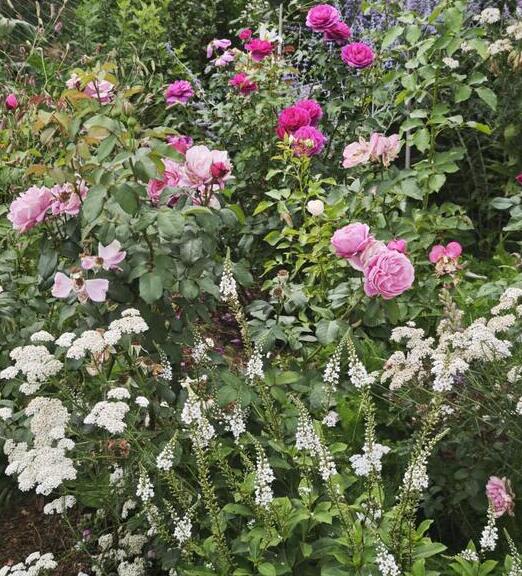
You will not find a hundred acres of a single species standing alone in nature. A forest is a stacked, tangled mess of different root systems, different bloom times, different chemical signatures — and that mess is exactly what makes it so resistant to any one pest or disease running unchecked through the whole thing.
Same root-exudate story as above, just bigger. Different plants send out different exudates, and each kind seems to draw in its own crowd of microbes, so a bed with several kinds of plants growing through it ends up with a busier, more varied soil community than one growing nothing but roses and mulch. And busier soil holds onto water better, does a better job of freeing up nutrients for the roots, and in my experience just grows sturdier roses.
I actually leaned into this one spring, standing over ‘Falstaff’ with tight curls of aphids on every soft new tip, seriously considering ordering a box of predator insects online. Instead I sowed a ribbon of sweet alyssum and dill between the roses, put out a shallow dish of water with a few pebbles in it, and opened up the center of the bush so air could move through. Then I waited. Within a week I found lacewing eggs strung along their hair-thin stalks, a ladybug larva working its way down the underside of a leaf, hoverflies going in and out of the alyssum. I hadn’t bought a single insect. I’d just given them a reason to stick around.

Here’s roughly how I lay it out: a clump or two of something in flower for every three or four roses, staggered so there’s always nectar available — alyssum, calendula, or borage early on, dill, coriander left to bolt, fennel, or buckwheat through the middle of the season, yarrow, cosmos, or flowering basil carrying it into late summer. Keeping something blooming that whole stretch is what actually keeps the adult lacewings, ladybugs, hoverflies, and parasitic wasps around; their larvae do the aphid-hunting. Still, the adults need nectar to bother staying long enough to lay eggs nearby. One thing I want to be honest about: nasturtiums get recommended constantly as an aphid trap crop, and I went looking for real research backing that up on roses specifically. I couldn’t find any. It’s the kind of thing that sounds true because everyone repeats it, not because anyone’s actually tested it. Planting for the predators themselves is the part that’s actually proven to work.
A shallow dish of water with a few pebbles in it (so nothing drowns) and a small patch left with leaf litter and hollow stems over winter round this out — that’s housing and a water source for the allies you just invited. It costs you a bit of autumn tidiness in exchange for a garden that’s already stocked with help by the time pests show up in spring.
Lesson four: even a forest thins itself
Watch a healthy forest long enough, and you’ll notice it isn’t actually chaos. Trees compete for light, the weakest lower limbs die back and drop away, and what’s left standing has room to breathe. That self-thinning is a big part of why disease doesn’t run rampant through a healthy stand — damp, stagnant, shaded air is where fungal spores thrive, and a forest, left alone, keeps working against exactly that condition.
A rose bush doesn’t self-thin the way a beech tree does, so this is the one lesson where you have to stand in for what nature would otherwise do herself. Pruning isn’t about taming a rose into a tidy shape. It’s about helping it breathe, make sugar, and stay out of trouble. Black spot and rust both need prolonged leaf wetness to establish; an open, airy canopy dries out by mid-morning; a crowded one stays damp and miserable most of the day. More light reaching the interior of the bush means more photosynthesis, which means more sugar in the sap, which is directly tied to a stronger natural defense response. I aim for what I think of as a loose vase shape, with somewhere around 40 to 60 percent canopy porosity. If a small bird couldn’t fly straight through the middle of your rose, it’s still too dense.
Lesson five: nothing is wasted
Walk through any forest in autumn, and you’ll see the entire operating budget of the ecosystem lying on the ground — leaves, bark, a fallen branch, a dead beetle. None of it gets hauled away. It gets broken down, layer by layer, by the exact organisms described above, and becomes next year’s growth. There’s no fertilizer truck. The forest recycles itself, endlessly, with nothing considered waste.
That’s the whole logic behind treating compost as a biological amendment rather than just a nitrogen-phosphorus-potassium delivery system. Good compost, made with a mix of greens and browns and a little soil or forest litter worked in, isn’t just decayed material — it’s a microbial community you’re introducing wholesale, one that drives nutrient cycling and suppresses disease on its own, quietly, in the background, the same way it does under a tree. An aerated compost tea, brewed fresh from that same living compost, does the same job as a foliar or root drench, multiplying the beneficial organisms and sending them straight to where the plant needs them most.
I can tell you exactly what this looked like in practice in my own garden, because I lived through the comparison firsthand. One season, following advice from what I’d call “modern rose expert” wisdom at the time, I sprayed fungicides regularly and preventively, before I ever saw a symptom, trying to shield the plants from anything that might go wrong.
By midsummer I’d had a visit from pretty much every rose disease there is — black spot, rust, mildew, the lot. Aphids showed up in waves. My ladybugs disappeared. Even the soil felt different underfoot, flatter, deadlier somehow. So the next season I stopped. Cold. No fungicides, no insecticides. I switched to compost teas, whey sprayed straight onto the leaves, herbal extracts I brewed myself, and spent that whole season just trying to undo what I’d been doing without realizing it. The difference wasn’t small. My roses bloomed harder than they had in years, pest pressure fell by more than 80 percent, and when something did show up, it stayed put in one corner instead of tearing through the whole garden.
A simple forest-inspired starting plan for this week
You don’t need to overhaul your whole garden at once. Pick two or three of these and start there.
Cover the soil. Lay 5 to 7 cm of mulch — grass clippings, shredded leaves, aged compost, whatever you have — under every rose, leaving a 10 to 15 cm clear ring around the stems. If it’s already mulched, check whether the layer is shrinking (good) or sitting untouched and dry (a soil-biology problem worth a scoop of compost tea).
Borrow a handful of forest soil. Next time you’re near a healthy, undisturbed patch of woods or hedgerow, take a cup or two of the dark soil under the leaf litter and work it into your compost pile or bury a scoop under the mulch near a rose that’s been struggling.
Plant for the helpers, not just the flowers. Tuck in a few clumps of alyssum, dill, or yarrow between your roses this season, and let one coriander or fennel plant bolt instead of pulling it. Set out a shallow dish of water nearby.
Open the center. Next time you prune, take out anything crossing, inward-facing, or touching the soil, and check whether light actually reaches the middle of the bush.
Make one batch of compost tea or extract from your best finished compost and use it as a root drench the next time you’d normally reach for a bottled product.
None of this needs to happen in a single afternoon. Forests didn’t build themselves overnight either.
Where all of this comes from
Everything in this article — the forest soil inoculation method, the full soil food web explanation, the mulch protocol, the predator refuge design, and the real story of the season I stopped spraying — comes straight out of the system I lay out in full in my book: Revolution in the Rose Garden — Organic Rose Gardening: Building Living Soil, Preventing Disease Naturally, and Growing Strong, Beautiful Roses Without Chemicals. If this way of thinking about your garden makes sense to you, that’s where the whole method lives, recipes and all. And if a rose of yours is alive but stubbornly refusing to thrive or bloom, I wrote a full troubleshooting guide for exactly that: Why Doesn’t My Rose Grow and Bloom? 100 Reasons and Solutions.
FAQ
Mostly because forest soil is alive and diverse in a way most garden soil isn’t. A thick, undisturbed layer of leaf litter feeds a dense underground community of bacteria, fungi, and other organisms that outcompete disease-causing pathogens, while covered soil and varied plant life keep fungal spores from splashing up onto leaves the way they do in bare, exposed garden beds.
It’s collecting a cup or two of soil from underneath the leaf litter in a healthy, undisturbed forest or hedgerow and mixing it into compost or burying a scoop under garden mulch. That soil carries mycorrhizal fungi, nitrogen-fixing bacteria, and other beneficial microbes that help rebuild a diverse, disease-suppressive soil community in your own garden.
Yes — they do different jobs, and I use all of them together in my own garden. Forest soil brings broad, established microbial diversity. A Trichoderma or EM product adds specific, well-studied organisms in reliable concentrations that are harder to guarantee from a random handful of soil. Both work best in soil that already has organic matter and biological activity to support them, which is exactly why mulch, compost, and forest soil inoculation come first — they build the living environment a purchased product needs to actually colonize and perform.
Aim for 5 to 7 cm of organic mulch, and leave a clear ring of 10 to 15 cm around the base of each rose. Mulch touching the stems directly holds moisture against the crown and invites rot and fungal disease.
Watch the mulch. If it’s visibly shrinking and being incorporated into the soil over a few weeks, that’s a strong sign of an active, living soil food web. Mulch that lingers unchanged for months, stays dry underneath, or starts smelling sour points to weak soil biology that needs feeding — with compost tea, forest soil, or finished compost — rather than more mulch piled on top.
Preventive, routine spraying causes the most damage because it doesn’t distinguish between the pathogen and the beneficial microbes living on the leaf surface and in the soil that are part of the plant’s natural defense. Most of the visible change comes from reducing or eliminating preventive spraying and letting living soil and predator populations rebuild.
It works at any scale. The mechanisms covered soil, diverse plantings, living compost, and an open canopy apply the same way to three rose bushes against a fence as they do to a large garden. What matters is the principle, not the acreage.