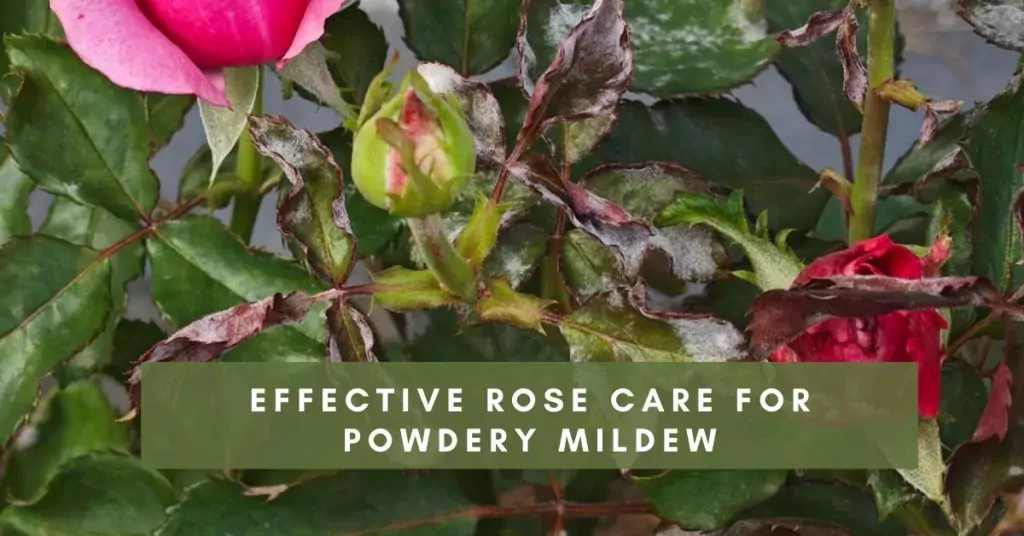
Effective Rose Care for Powdery Mildew

Powdery Mildew on Roses: The Organic Prevention and Cure Guide That Actually Works

Late June, my garden, seven in the morning. The nights had been cool, the days warm and dry, and I walked past Queen of Sweden rose and saw what looked like somebody had dusted her new growth with flour. Not spots. Not a rash. A fine, even, white coating, as she’d walked through a bakery. That’s powdery mildew on roses, and if you’ve gardened for more than a season, you’ve met her too.
Here’s what nobody tells you when you go looking for organic treatment for powdery mildew on roses: half the advice floating around the internet is outdated, a chunk of it is actively backward, and the part that’s actually true — that baking soda isn’t the same thing as the product that works — almost never gets explained. So I went back through the plant pathology research, cross-checked it against what’s actually happened on my own bushes over the years, and rebuilt this guide from the ground up. Prevention first, because that’s where 80 percent of the battle is won or lost. Then what to do once you see that first dusting, because sometimes prevention isn’t enough and you need a real plan, not a Pinterest recipe.

What Is Powdery Mildew?
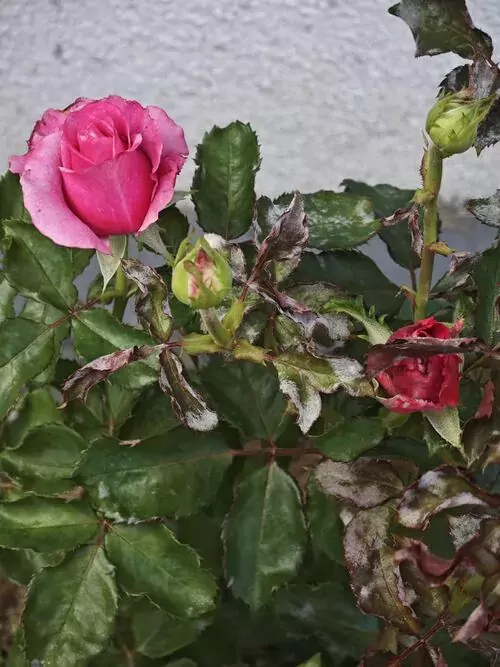
The fungus behind it has a name: Podosphaera pannosa var. rosae, and it’s a specialist — it doesn’t wander over from your zucchini or your lilac; it evolved specifically to live on roses. It’s what plant pathologists call an obligate biotroph, meaning it can only survive on living rose tissue. It doesn’t kill the leaf outright the way black spot does; it sits on the surface, feeding off it, weakening it slowly.
You’ll see it first on new growth — young leaves, the tips of canes, unopened buds — because that soft tissue is what the fungus prefers. Early on, it’s a light, almost powdery bloom you can rub off with a finger. Left alone, leaves curl, stunt, and drop early; buds can stay sealed shut or open into deformed, undersized blooms. It rarely kills a mature rose outright, but a bad summer of it will visibly set a bush back, and a young or stressed plant can suffer real damage.
Powdery Mildew roses

Powdery Mildew vs. downy mildew

I still get messages in my Facebook group asking why the “powdery mildew treatment” isn’t working, and half the time, it’s not powdery mildew at all.
Powdery mildew gives you a bright white, genuinely powdery film on the top of leaves, on stems, on buds. It shows up in warm, dry weather with cool nights, and it thrives in shade and crowding.
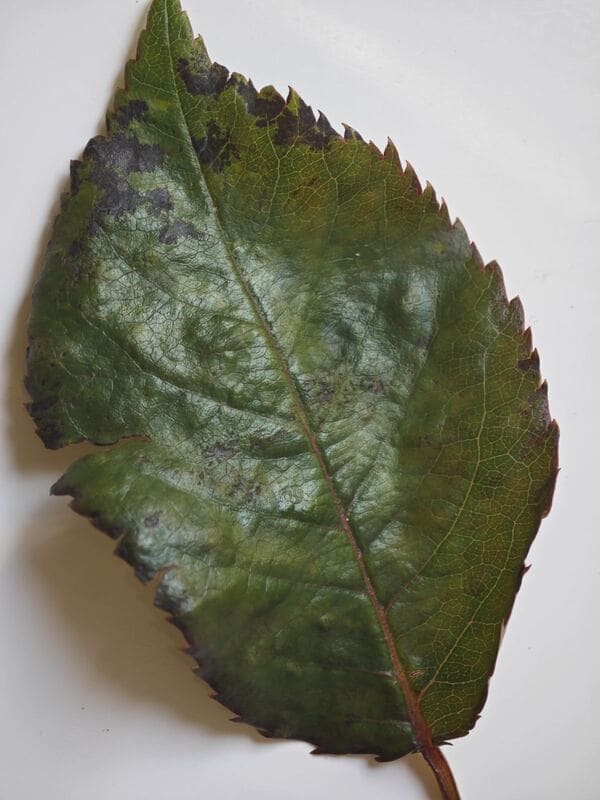
Downy mildew is a different organism entirely (Peronospora sparsa), and it looks nothing like flour once you know what to check. Look for purplish-red or dark angular blotches on the upper leaf surface, with a faint grayish fuzz on the underside directly beneath the spots and it shows up after wet, unsettled weather, not dry spells. Downy mildew can defoliate a bush shockingly fast, in days, and it needs a completely different response, which is a whole separate article.
If what you’re looking at rubs off like flour between your fingers, you’re dealing with powdery mildew. If it doesn’t rub off and the leaf underneath looks bruised, it’s something else.
Powdery Mildew rose

 Powdery Mildew

 downy mildew

The part that surprised me: powdery mildew doesn’t need rain at all

This is the single most useful thing to understand about this disease, and it’s the opposite of what most people assume.
Almost every other fungal disease in the rose bed — black spot, downy mildew, botrytis — needs a film of water on the leaf to germinate and infect. Powdery mildew doesn’t. Its spores can germinate using just the humidity in the air around the leaf, with no free water required at all. Worse for us: standing water on the leaf surface for any length of time actually kills most powdery mildew spores. That’s the opposite of black spot, where wet leaves are the whole problem.
So the textbook conditions are warm, dry days paired with cool, humid nights and shaded, still air — classic late-spring and early-summer weather in a lot of climates, and honestly a pretty accurate description of a Tbilisi June. The fungus grows best somewhere between 60°F and 80°F (roughly 16–27°C), with its sweet spot around 73°F. Push much past 90–95°F and it actually struggles, which is part of why a hot August lull can look like your spray program is working when really the weather did some of the work for you.
One practical result of this biology: the old advice to keep water completely off the foliage “just in case” isn’t quite right for powdery mildew specifically. A firm blast of water from the hose, aimed at infected stems and buds two or three times a week, in the morning so leaves dry by evening, physically knocks conidia off the plant and can meaningfully reduce pressure. It’s one of the few free, zero-input tools you have, and it’s underused because everyone’s been trained to fear wet rose leaves.

Organic prevention for powdery mildew on roses: what actually moves the needle

Prevention is where I’d put most of your effort, because once the fungus is established on soft new growth, you’re managing it, not curing it in one shot.
Give the bush air. Space plants so the centers of neighboring bushes don’t touch at maturity, and prune each spring to open up the middle of the plant — take out crossing canes and anything growing inward. Powdery mildew loves still, humid, shaded air pockets, and airflow is the cheapest fungicide you own.
Plant in full sun. Six hours minimum. Shade is one of the strongest predictors of a bad mildew year on an otherwise healthy bush.
Go easy on nitrogen. This one took me a while to really absorb: soft, lush, nitrogen-fed new growth is exactly the tissue this fungus prefers. A rose pushed hard with fast nitrogen in early summer is handing the fungus a buffet. Feed for steady, moderate growth instead of compost, aged manure, slow-release organic feeds — not a spike-and-crash routine.
Choose resistant varieties where you can. Not every rose is equally vulnerable. Iceberg, Julia Child, Electron, Europeana, and the climbing rose Dublin Bay all have documented resistance, and most Rosa rugosa types shrug the disease off almost entirely. If a particular bed in your garden gets hit every single year regardless of what you do, that’s a strong argument for swapping the variety, not spraying harder.
Clean up religiously. Rake and remove fallen leaves through the season, and prune out and destroy, not home-compost — canes that were badly infected. The fungus overwinters in bud scales and on infected wood as tiny survival structures called chasmothecia, waiting for next spring. Every leaf you leave on the ground is a head start for next year’s outbreak.
Prime the plant’s own defenses. This is where my own protocol goes further than the average prevention list. Seaweed extract and chitosan do more than feed the plant. Applied as a foliar spray, chitosan triggers the rose’s own induced systemic resistance response, putting the plant’s immune system on alert before the fungus ever lands. A study on Rosa roxburghii — an actual rose, not a stand-in crop — found that chitosan combined with a plant-derived antifungal compound significantly suppressed powdery mildew, and separate research on peas found seaweed extract and chitosan together outperformed either one alone. I spray mine every two to three weeks through the vulnerable months, starting before I see any symptoms, not after. 

Organic treatment once you actually see it

If prevention didn’t hold the line and you’re staring at that white dusting, here’s the order I actually work through, cheapest and gentlest first.

Stop feeding the fire

Prune out the worst-affected shoot tips right away you’re removing the fungus along with the tissue it’s living on, and you’re redirecting the plant’s energy away from the soft growth mildew loves. Bag it or burn it, don’t toss it on the compost heap.

Potassium bicarbonate — not baking soda

This is the correction I most wanted to make to this article, because the old advice conflated two different things. Baking soda is sodium bicarbonate. The product that’s actually been tested in controlled trials, repeatedly, with real efficacy against powdery mildew, is potassium bicarbonate — sold under names like MilStop or Armicarb. They sound like the same idea, but they’re not the same salt, and the research base is built almost entirely around the potassium version. Baking soda’s sodium content can build up in the soil and cause leaf burn over repeated use, without the same track record of results.
Potassium bicarbonate works partly as a contact eradicant — it disrupts the fungus’s ion balance and collapses the cell walls of the mildew growing on the leaf surface — which is actually a rare thing among organic options: most of what’s on this list prevents infection, but bicarbonate can knock back mildew that’s already there. Use it early in an outbreak. On advanced, heavily coated leaves it can cause its own leaf damage, because it’s killing fungal tissue fused to plant tissue all at once. Mix per your product’s label, add a few drops of horticultural soap so it actually sticks to the leaf, and apply in the cool of morning or evening, never in full midday sun.

Sulfur, timed carefully

Sulfur is one of the oldest organic fungicides there is, and it still earns its place — but it works almost entirely as a preventive, not a cure. It acts as a vapor around the leaf surface that stops spores from germinating in the first place, so it’s most useful applied before an outbreak or at the very first sign of one. Two hard rules: never apply it above roughly 85°F, since it can scorch foliage in heat, and never apply it within two to three weeks of an oil spray (including neem oil) the combination burns leaves badly. Pick one or the other for a given stretch of the season.

Neem oil or horticultural oil

Oils work by physically smothering the fungal structures on the leaf surface — a mechanical action more than a chemical poison, which is part of why resistance to it is less of a concern than with some other treatments. It’s useful on mild to moderate infections as an eradicant, less so once mildew has really taken hold. Same heat rule as sulfur: skip it above 90°F, and keep it well clear of any sulfur application by at least two weeks.

Milk spray — genuinely useful, just not magic

I know this sounds like the kind of folk remedy this whole checklist tries to weed out, but milk spray actually has real research behind it, tested against powdery mildew on grapes, zucchini, pumpkin, and strawberries, with consistently positive if modest results. Mix roughly one part milk to nine or ten parts water and spray weekly. Nobody has fully nailed down the exact mechanism — the leading theories involve whey proteins and compounds that generate mild antifungal free radicals when they hit sunlight on the leaf surface — but the effect shows up across enough independent studies that I don’t dismiss it. I’d treat it as a solid low-cost tool for light, early infections or as part of a rotation, not a stand-alone fix for a bush that’s already heavily coated.

Bacillus subtilis biofungicides

Products built around Bacillus subtilis (Serenade is the common one) work by colonizing the leaf surface ahead of the pathogen and producing antifungal compounds that make it harder for mildew spores to establish. This is a preventive tool, not a rescue treatment — it needs to be on the leaf before the fungus arrives to do much good, which is exactly why it belongs in the same rotating spray calendar as your chitosan and seaweed applications, not pulled out only once you’ve spotted trouble.

My recommendations:

Disease prevention

Where I’d put Trichoderma, honestly

I use Trichoderma primarily as a soil drench for root health and to crowd out root-rot pathogens — that’s the well-established use, and it’s what my Trichoderma guide covers in full. Once a month, I also spray it directly on the foliage, the same day I drench the roots, more as a general biological-coverage habit than a treatment I’m running as a controlled trial against powdery mildew specifically. There’s research on specific Trichoderma strains used as a foliar spray alongside sulfur against powdery mildew in vineyards, with promising results, which is part of why I keep the foliar pass in my own rotation. I haven’t measured how much of my results come from that piece alone versus everything else I’m doing, so I’ll say this honestly: it’s a reasonable bet backed by research in other crops, not a proven rose protocol on its own.

What I’d skip

Garlic infusion shows up in almost every home-remedy list for powdery mildew, and I genuinely could not find solid, controlled research behind it working on this specific fungus. Anecdote, yes. Data, not really. I don’t spray it anymore.
Wood ash sprays are the other one I dropped from this article. There’s no real evidence it does anything to powdery mildew directly — what it reliably does is raise pH, both on the leaf and in the soil underneath if it drifts down and accumulates. If you garden anywhere near my kind of alkaline, limestone-based soil, that’s the last thing you want to be adding on top of an iron chlorosis risk you’re probably already managing. Skip it here; save your wood ash for compost instead.

My actual rotation, month by month

In my garden, prevention runs on a calendar, not a reaction to what I see. Twice a month, it’s seaweed extract and chitosan together, my main immune-priming spray. Twice a month, on the weeks in between, I switch to Bacillus subtilis paired with EM (effective microorganisms, a mixed beneficial-microbe brew) — so between the two, something preventive is going down roughly every week. Once a month, Trichoderma gets its own day: a foliar spray on the leaves and a drench at the root zone on the same afternoon, covering the canopy and the soil in one pass. If a variety I know is mildew-prone starts pushing soft new growth after a feed. The moment I spot that first dusting on a tip, I prune it out, switch to whey for that plant specifically, and give it a firm water rinse twice a week until the pressure drops. I don’t run every product at once, and I give each treatment a real week or two to show whether it’s working before I layer on something else.

When to just accept the season and move on

Some summers, a chronically mildew-prone rose in a shady, crowded corner is going to get it no matter what you do, and that’s worth knowing rather than fighting. If a bush gets hit hard three years running in the same spot, the more honest fix is moving it, thinning what’s crowding it, or accepting that it’s the wrong variety for that microclimate and replacing it with something on the resistant list. I’ve done all three in my own garden, and every time, it was less work than another summer of spraying a plant that was destined to struggle anyway.

Want the complete system?

If you want the complete organic system this protocol comes from — the soil biology, the feeding rhythm, and the disease prevention approach that keeps roses like mine mostly out of trouble before it starts — that’s exactly what my book covers: Revolution in the Rose Garden — Organic Rose Gardening: Building Living Soil, Preventing Disease Naturally, and Growing Strong, Beautiful Roses Without Chemicals. And if a rose is technically alive but won’t thrive no matter what you try, I wrote an entire troubleshooting guide for exactly that: Why Doesn’t My Rose Grow and Bloom? 100 Reasons and Solutions.

Rose gardening books

Step into a calmer, more confident rose season. With Ann Devis’s rose gardening books and planner, you’ll get simple organic routines, proven tips, and checklists that keep your roses thriving – from first bud to last bloom.

FAQs

A specialized fungus, Podosphaera pannosa var. rosae, that thrives in warm days paired with cool, humid nights and shaded, crowded, still air. Unlike most rose diseases, it doesn’t need rain or wet leaves to infect — humidity in the air is enough.
No, and this is one of the most persistent myths out there. Powdery mildew spores actually die on leaves that stay wet for an extended period. A firm water rinse in the morning, so leaves dry by evening, can physically knock spores off the plant and help control an outbreak rather than cause one.
Weakly, at best. The research supporting bicarbonate sprays is built around potassium bicarbonate, not baking soda’s sodium bicarbonate. They’re chemically different salts, and baking soda lacks the same track record while carrying a real risk of sodium buildup and leaf burn with repeated use. If you want a bicarbonate spray, use a potassium bicarbonate product.
There’s genuine research behind it — studies on grapes, zucchini, pumpkin, and strawberries all show a real, if modest, reduction in powdery mildew from diluted milk sprays (roughly 1 part milk to 9–10 parts water, applied weekly). It’s a solid low-cost tool for light or early infections, not a replacement for a full prevention program on a heavily affected bush.
Rarely outright, on an established plant. It weakens the bush by damaging leaves and reducing photosynthesis, stunts new growth, and can deform buds and blooms. A young, newly planted, or already-stressed rose is at real risk of lasting damage from a bad, untreated case.
Powdery mildew is a bright white, powdery coating that shows up in dry, warm weather. Downy mildew causes purplish-red or dark angular blotches with faint gray fuzz underneath, and it follows wet, humid, unsettled weather — it’s a different organism entirely and spreads much faster.
Every two to three weeks through your region’s warm-day, cool-night stretch of the season, alternating or combining seaweed extract, chitosan, and preventive sulfur or Bacillus subtilis applications — started before symptoms appear, not after.

Leave a Comment

Sign In

Register

Reset Password

Please enter your username or email address, you will receive a link to create a new password via email.

Scroll to Top