
Someone posted in my Facebook group last week with a photo: half her rose bush had gone yellow, and she was already reaching for a fungicide. “Is this the black spot everyone talks about?” It wasn’t. It was tap water and a pot with no drainage hole. Two completely different roses, two completely different problems — and if she’d sprayed for a fungus that wasn’t there, she’d have spent money, wasted a weekend, and the actual issue would have gotten worse while she waited for results that were never going to come.
That’s the trouble with “rose leaves turning yellow” as a search term. It isn’t one problem. It’s a symptom that at least six different problems can produce, and the fix for one can be actively wrong for another — feed nitrogen to a rose with iron chlorosis and you’ll push out more pale new growth, not fix a thing.
So here’s how I actually work through it, in the order I check things myself, before I touch a single spray bottle.
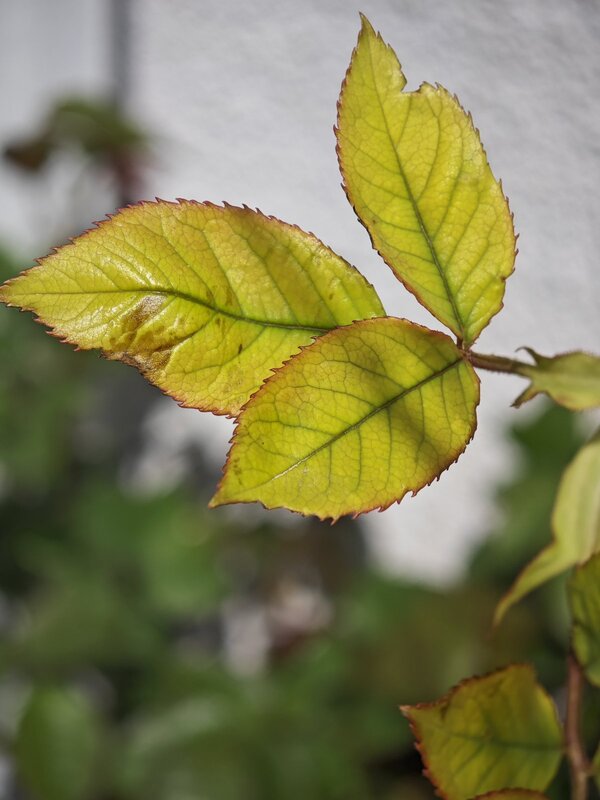
The 60-second look: where are the yellow leaves, and what pattern do they make?
Two questions get you most of the way to an answer, and neither requires a lab.
Which leaves are yellow — old ones near the base, or new growth at the tips? Old, lower leaves yellowing first usually points to nitrogen deficiency. New leaves at the top going yellow first usually points to iron chlorosis.
Is the whole leaf yellow, or just the tissue between the veins, with the veins staying green? Whole-leaf, uniform yellowing leans nitrogen or overwatering. Yellow between green veins — what’s technically called interveinal chlorosis — leans iron or magnesium, and which one depends on where on the plant you’re seeing it.
Are there also black or purple spots ringed in yellow? That’s not a deficiency at all. That’s black spot, a fungal disease, and it needs a completely different response — I’ve written a full organic protocol for it separately, since it deserves its own space.
Hold those two or three answers in your head, and the rest of this guide will make a lot more sense.
Cause 1: Nitrogen deficiency — old leaves, uniform pale yellow, veins included
Nitrogen is what plant scientists call “mobile.” When the rose doesn’t have enough of it, it pulls nitrogen out of older leaves and ships it to new growth and buds, because that’s where it matters most for survival. The old leaf, stripped of nitrogen, goes uniformly pale yellow, veins and all, then drops. It’s not damage exactly. It’s the plant triaging itself.
You’ll see this most on roses in poor or sandy soil, in pots that haven’t been fed in a while, or after a heavy bloom flush that pulled resources hard.
Organic fix: fish emulsion diluted per the label (usually about 2 tablespoons per gallon of water), applied as a soil drench every two to three weeks through the growing season. Alfalfa meal or alfalfa tea works as a slower-release option — a cup of alfalfa meal worked into the soil around each bush, watered in, repeated monthly. Well-rotted compost as a spring and midsummer topdressing does the same job on a longer timeline and improves the soil doing it, which a bagged fertilizer never will.
Don’t reach for a fast synthetic nitrogen boost here even if you have some on the shelf a sudden nitrogen spike pushes soft, sappy new growth that aphids and fungal spores both find irresistible. Slow and steady beats fast and soft.
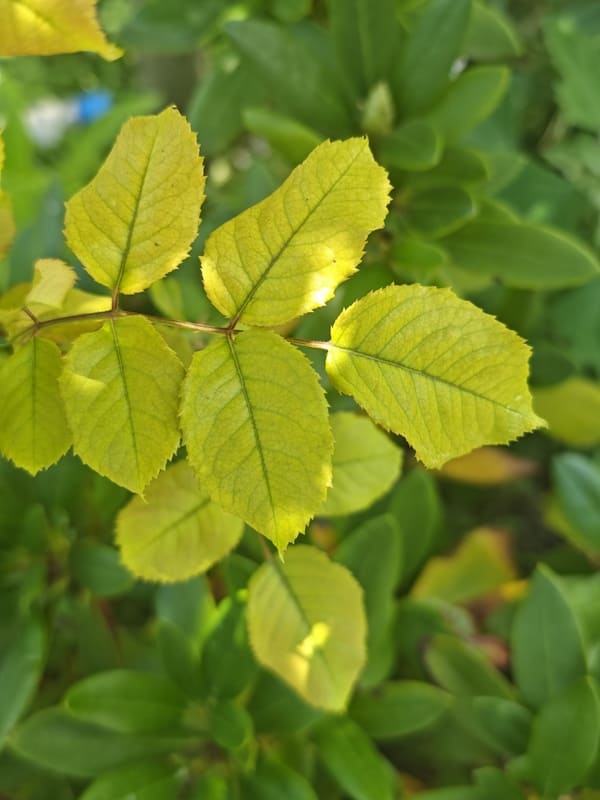
Cause 2: Iron chlorosis — new leaves, veins stay green, soil runs alkaline
This is the one that trips people up, because it looks like a plant that isn’t getting fed, when actually the iron is usually sitting right there in the soil. The problem is availability, not supply. Above roughly pH 6.5–7, iron reacts with the soil chemistry and locks into a form the roots can’t absorb. It doesn’t matter how much iron is technically present if the pH is wrong; the rose can’t reach it. That’s why this shows up first on the newest leaves at the tips of the plant: iron doesn’t move around inside the plant the way nitrogen does, so new growth can’t borrow it from older leaves the way it can with more mobile nutrients.
Gardening in Tbilisi, this is one I watch every spring without fail — our soil sits on limestone bedrock, and alkaline, iron-locking conditions come with the territory here, not the exception.
Organic fix, in the right order:
Treat the soil chemistry before you treat the symptom, or you’ll be reapplying iron forever. Elemental sulfur worked into the soil gradually lowers pH over a season or two — test first, since overcorrecting creates its own problems. Mulching with pine needles or peat moss nudges pH down more gently and slowly over time. For a faster, visible response while the soil chemistry catches up, a foliar spray of liquid seaweed (kelp extract) supplies iron in a form the leaf can take up directly, temporarily bypassing the soil problem. Chelated iron products exist for this too, but check the chelating agent — some are synthetic and outside an organic program, so read the label rather than assuming.
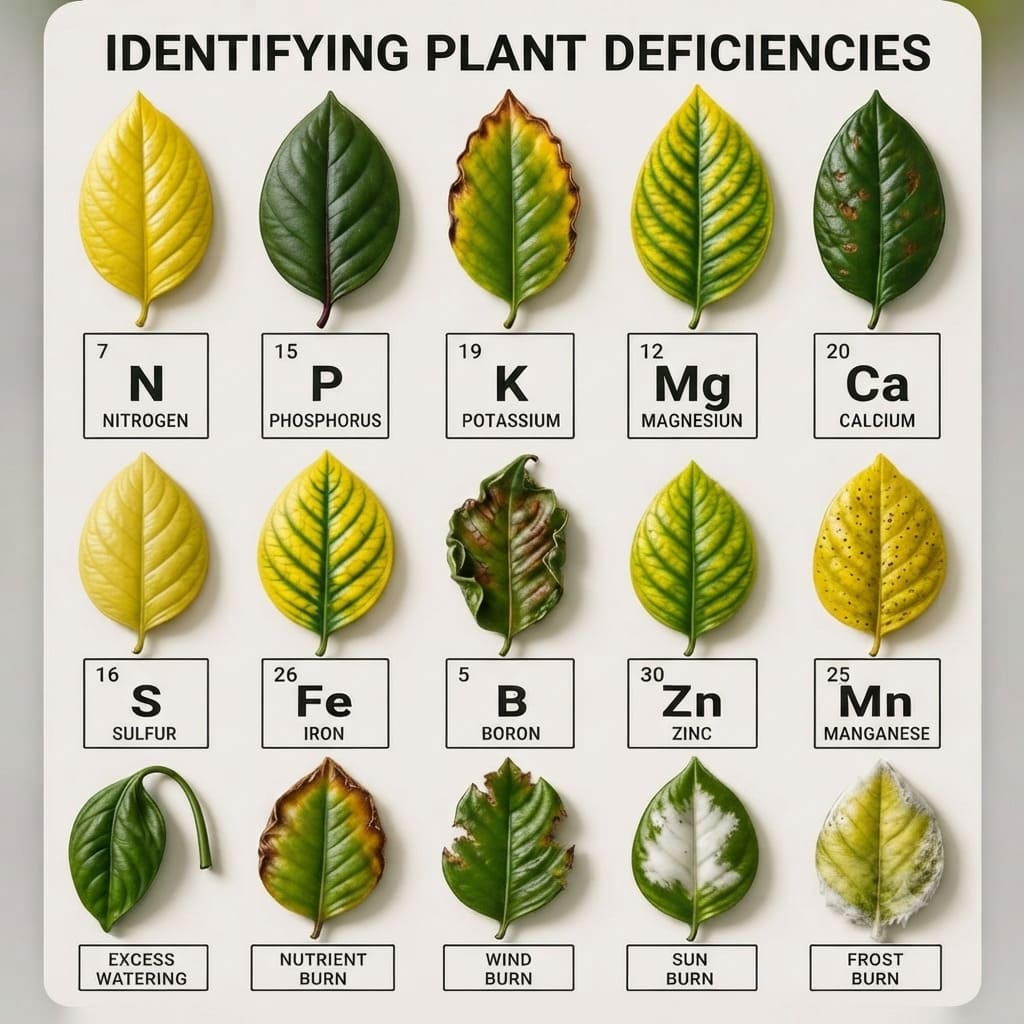
Cause 3: Magnesium deficiency — mid-to-lower leaves, interveinal yellow with a reddish tinge
Magnesium deficiency likes to show up right when your roses are blooming hardest, because magnesium is what builds chlorophyll, and a rose pouring everything into flowers can run short. Look for it on the middle-to-lower leaves rather than the newest growth, with a reddish or purplish tint mixed into the yellow between the veins — that reddish cast is the detail that separates it from iron chlorosis at a glance.
This tends to concentrate in sandy or heavily leached soil, where magnesium washes through before the roots can use it.
Organic fix: Epsom salt (magnesium sulfate) dissolved at about 1 tablespoon per gallon of water, applied as a soil drench around the root zone, or as a foliar spray for a quicker response. Most gardens only need this once a season — it’s not something to add to your regular feeding rotation by default, just when the reddish interveinal pattern actually shows up. Expect to see a difference in new growth within a couple of weeks, not on the leaves that are already yellow.
Cause 4: Overwatering and suffocated roots — whole leaf yellow, plant wilts despite wet soil
This is the one that fools people the most, because the instinct when a plant looks unhappy is to water it more, and that’s exactly backwards here.
Roots need oxygen as much as they need water. In waterlogged or compacted soil, the air pockets between soil particles fill with water, root hairs suffocate and die back, and a rose with damaged roots can’t take up nutrients properly even if the soil is full of them — so you get yellowing that looks like a feeding problem but is actually a plumbing problem. The giveaway is a plant that wilts on a hot afternoon despite soil that’s clearly still wet two inches down, plus yellowing that hits whole leaves rather than following a vein pattern.
Organic fix: first, stop and check — dig down two to three inches before you water again, and only water when it’s actually dry there. If your soil is heavy clay, work in compost to open up the structure, and consider raised beds or a change in bed grading if water is genuinely pooling around the crown. Once roots have been sitting wet, they’re vulnerable to rot fungi, and this is where I bring in Trichoderma — a beneficial fungus I use as a soil drench specifically to colonize the root zone and crowd out the pathogens that move in on stressed roots. I’ve written a full guide to how and when to apply it if you want the complete protocol.
Cause 5: Reverting to rootstock — different leaf shape, unusually vigorous growth from below the graft
Most roses sold today are grafted onto a hardier rootstock, and if the grafted variety weakens or dies back, the rootstock itself can send up its own growth, often with a different leaf shape, a different green, and noticeably more vigor than the rest of the bush. It’s not really “yellowing” in the deficiency sense, but I mention it here because gardeners confuse it with disease constantly. If you see a cane growing differently from everything else on the plant, trace it back to below the graft union, and remove it there rather than pruning it partway.
When it’s not a problem at all: natural leaf drop
Roses shed their oldest leaves as a matter of course; one leaf yellowing and dropping here and there, low on the plant, while the rest of the bush pushes healthy new growth, is completely normal aging, especially as the season turns toward autumn. The distinction that matters: is it a handful of scattered old leaves over weeks, or a fast, spreading pattern across the whole plant? The first is just a rose being a rose. The second is one of the causes above and worth acting on.
My working order when I see yellow leaves
I don’t run every test at once. I look at leaf position first, then pattern, then check for spots or webbing, then dig down to check the soil moisture. In that order, four questions usually get me to an answer before I’ve touched a single product — which, honestly, is the whole point of a diagnostic approach instead of a “spray and hope” one.
If you want the complete system behind all of this — the feeding rhythm, the soil biology, the pH management, the whole living-soil approach that prevents most of these problems before they start — that’s exactly what my book covers: Revolution in the Rose Garden — Organic Rose Gardening: Building Living Soil, Preventing Disease Naturally, and Growing Strong, Beautiful Roses Without Chemicals. And if your rose is technically alive but refusing to thrive or bloom the way it should, I wrote an entire troubleshooting guide for exactly that: Why Doesn’t My Rose Grow and Bloom? 100 Reasons and Solutions.
Rose gardening books

Step into a calmer, more confident rose season. With Ann Devis’s rose gardening books and planner, you’ll get simple organic routines, proven tips, and checklists that keep your roses thriving – from first bud to last bloom.
Frequently Asked Questions
Check two things: which leaves, and what pattern. Nitrogen deficiency hits old, lower leaves with uniform yellowing, veins included. Iron chlorosis hits new, upper leaves with yellowing between the veins while the veins themselves stay green.
Only if the cause is magnesium deficiency — look for a reddish tinge mixed into interveinal yellowing on the middle-to-lower leaves. Epsom salt won’t help nitrogen deficiency or iron chlorosis, and using it as a general “just in case” feed isn’t necessary for most gardens.
Yes, in small amounts. Roses continuously shed their oldest leaves as part of normal growth, especially heading into autumn. Worry when it’s fast, widespread, or paired with wilting — not when it’s a scattered leaf or two low on an otherwise healthy plant.
Yes. Surface soil dries out quickly while the root zone underneath stays saturated, especially in clay or compacted soil. Dig down two to three inches before assuming the plant needs water — that’s the only reliable check.
No. Black or purple spots ringed in yellow point to black spot, a fungal disease that needs its own organic treatment protocol, not a feeding fix. Treating it as a nutrient problem will waste time while the fungus keeps spreading.
Foliar sprays like seaweed extract show a difference within days to two weeks. Soil-based fixes — compost, alfalfa meal, sulfur for pH correction — work on a slower timeline, often four to eight weeks, because they’re rebuilding soil chemistry and biology rather than patching a leaf directly. Already-yellow leaves usually don’t turn green again; look for the improvement in the next flush of new growth instead.


