
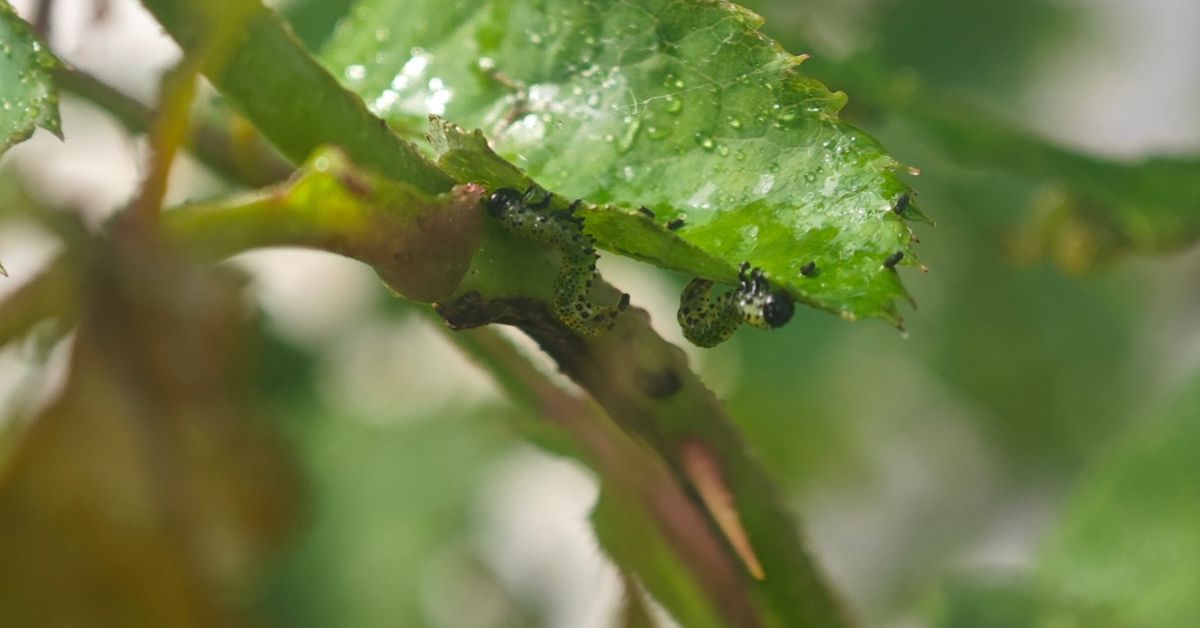
A caterpillar is the larva of a butterfly or moth. It may look harmless, but in just one day, it can eat an entire leaf or chew through a stem. If you miss the early signs, the population can explode within a week and turn into a real army.
This article covers only organic methods that actually work in a real garden. No harsh chemicals, no danger to bees, children, or pets.
How to Spot Caterpillar Damage Before It's Too Late
The signs usually show up before you see the caterpillars themselves:
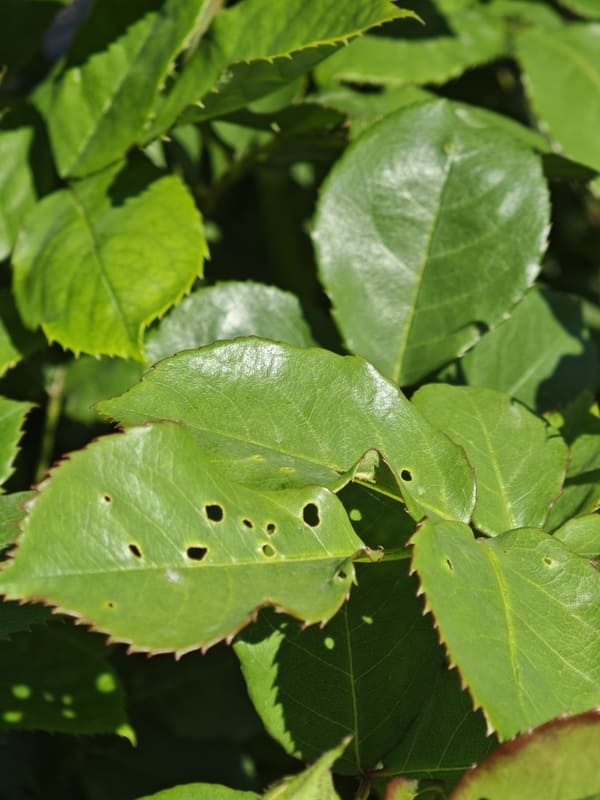
- Leaves develop round or stretched holes, with edges that look neatly cut by scissors. Sometimes only the leaf veins remain.
- On cabbage, the head becomes covered with green crumbs – caterpillar droppings hidden between the leaves.
- On roses, leaves curl into tubes (leafroller damage), or shoots turn black because a caterpillar has bored inside the stem.
- Fruits develop deep tunnels filled with frass – a mix of droppings and plant debris.
Caterpillars are most active at dusk and during the night. During the day, they hide on the underside of leaves, in bark cracks, under stones, or in the top layer of soil.
Why Chemicals Are Not Always the Best Choice
Contact insecticides kill everything indiscriminately – caterpillars, ladybugs, bees, and spiders. Systemic chemicals can penetrate edible crops and remain in plant tissues for weeks.
Organic methods work differently. They target the pest while preserving beneficial insects that naturally keep caterpillar populations under control.
Method 1. Hand Picking – Free and Immediate
For a small garden, this is often the most reliable solution, especially for roses, currant bushes, or a small cabbage bed.
Best time to collect caterpillars:
Early morning before 8 a.m. or evening after 7 p.m. At these times, they feed openly rather than hide.
Early morning before 8 a.m. or evening after 7 p.m. At these times, they feed openly rather than hide.
Where to look:
Turn over every leaf. Search for cabbage caterpillars deep between leaves near the base of the head. On roses, inspect rolled leaves and damaged shoot tips.
Turn over every leaf. Search for cabbage caterpillars deep between leaves near the base of the head. On roses, inspect rolled leaves and damaged shoot tips.
What to do with collected caterpillars:
Drop them into a jar of soapy water or place them on a path for birds to eat. Do not throw them into compost – many species survive and pupate there. Repeat 2 to 3 times a week for a month to break the breeding cycle.
Drop them into a jar of soapy water or place them on a path for birds to eat. Do not throw them into compost – many species survive and pupate there. Repeat 2 to 3 times a week for a month to break the breeding cycle.
Method 2. Bacillus thuringiensis (Bt) – The Main Weapon of Organic Gardeners
This soil bacterium is harmless to virtually all living creatures except caterpillars. It works like a highly specific key that only fits one lock in the caterpillar’s digestive system.
How it works:
The caterpillar eats a treated leaf. Inside its alkaline gut, Bt crystals dissolve and release a toxin. The toxin destroys the gut lining, causing the caterpillar to stop feeding and die within 24 to 72 hours.
The caterpillar eats a treated leaf. Inside its alkaline gut, Bt crystals dissolve and release a toxin. The toxin destroys the gut lining, causing the caterpillar to stop feeding and die within 24 to 72 hours.
Bt is completely safe for bees, ladybugs, birds, humans, and pets because their digestive systems are different and the toxin is never activated.
How to apply it correctly
Temperature:
Works best between 15°C and 25°C. Above 30°C, sunlight destroys the bacteria within hours, and effectiveness drops sharply.
Works best between 15°C and 25°C. Above 30°C, sunlight destroys the bacteria within hours, and effectiveness drops sharply.
Application time:
Spray only in the evening or on cloudy days. Morning sun and midday heat quickly break down the product.
Spray only in the evening or on cloudy days. Morning sun and midday heat quickly break down the product.
Important condition:
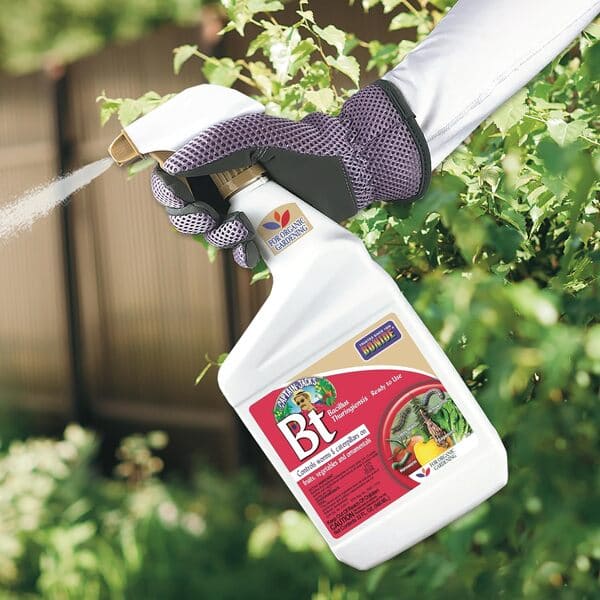
The caterpillar must eat the treated leaf. Bt is not a contact poison and does not absorb through the skin. Spray both the top and underside of leaves thoroughly, especially the undersides where caterpillars feed most often.
The caterpillar must eat the treated leaf. Bt is not a contact poison and does not absorb through the skin. Spray both the top and underside of leaves thoroughly, especially the undersides where caterpillars feed most often.
Repeat applications:
Every 5 to 7 days or immediately after heavy rain, because rain washes the bacteria off leaves.
Every 5 to 7 days or immediately after heavy rain, because rain washes the bacteria off leaves.
Important:
Do not mix Bt with copper or sulfur products in the same sprayer. Copper and sulfur kill the living bacteria. If you need to treat fungal diseases too, leave at least a 2-day gap.
Do not mix Bt with copper or sulfur products in the same sprayer. Copper and sulfur kill the living bacteria. If you need to treat fungal diseases too, leave at least a 2-day gap.
What to expect:
Caterpillars do not die instantly. They may continue feeding for 1 to 2 days after treatment. This is normal. Check again after 3 days. If they become sluggish, darken, or disappear, the treatment is working.
Caterpillars do not die instantly. They may continue feeding for 1 to 2 days after treatment. This is normal. Check again after 3 days. If they become sluggish, darken, or disappear, the treatment is working.
Bt is effective against butterfly and moth caterpillars such as cabbage worms, armyworms, loopers, leafrollers, and stem borers. It does not work on beetles, sawflies, or borers with different digestive systems.
Method 3. Fungal Biocontrols – Beauveria and Metarhizium
If your garden has not only caterpillars but also aphids, mites, or thrips, entomopathogenic fungi can help.
Beauveria bassiana:
This fungus grows through the insect’s outer shell and fills the body with white fungal threads. The caterpillar dies within 3 to 7 days and eventually looks covered in white fuzz.
This fungus grows through the insect’s outer shell and fills the body with white fungal threads. The caterpillar dies within 3 to 7 days and eventually looks covered in white fuzz.
Best conditions:
Humidity above 60% and temperatures between 18°C and 28°C. Performance drops in dry heat.
Humidity above 60% and temperatures between 18°C and 28°C. Performance drops in dry heat.
You can alternate it with Bt:
- Bt in the evening.
- Beauveria 2 days later in the morning.
Metarhizium anisopliae:
Another beneficial fungus is especially effective against cutworms, which hide in the soil during the day and feed at night. The fungus infects the caterpillar through contact in the soil.
Another beneficial fungus is especially effective against cutworms, which hide in the soil during the day and feed at night. The fungus infects the caterpillar through contact in the soil.
Both fungi are safe for bees when applied in the evening after bees stop flying.
Method 4. Plant-Based Sprays – For Prevention and Mild Infestations
Garlic infusion:
One of the easiest natural repellents.
One of the easiest natural repellents.
Crush 100 g of garlic, pour over 1 liter of water, and let it steep for 24 hours in a closed jar. Strain and add 1 teaspoon of liquid soap to help the spray stick to leaves. Apply in the evening.
Garlic discourages butterflies from laying eggs and suppresses small caterpillars on contact. Safe for bees once dry.
Tobacco infusion:
Stronger, but use it carefully.
Stronger, but use it carefully.
Mix 50 g of tobacco dust with 2 liters of water and steep for 2 days. Strain and dilute 1:10 with water.
It contains nicotine, which is toxic to caterpillars and beneficial insects alike. Use only on ornamental plants and never on flowering plants or edible crops close to harvest.

Pyrethrum :
A fast-acting natural insecticide.
A fast-acting natural insecticide.
Steep 30 g of dried flowers in 1 liter of hot water for an hour, strain, and add soap. It kills caterpillars within hours but breaks down in sunlight by the end of the day.
Neem oil:
A systemic organic protector.
A systemic organic protector.
Neem disrupts caterpillar hormones. They stop feeding, fail to molt properly, and die from starvation within 3 to 7 days. Neem also protects new leaves that grow after treatment.
Dilute according to the label, usually around 5 ml per liter of water. Add a sticker-spreader and spray in the evening. Safe for bees after drying.
Method 5. Mineral Powders – Diatomaceous Earth
Diatomaceous earth consists of microscopic fossilized algae skeletons. Their sharp edges damage the caterpillar’s protective coating, causing dehydration and death within 1 to 2 days.
Apply as a dry dust over leaves and stems, or mix 50 g per liter of water and spray. It works only in dry weather because rain removes it.
Safe for people, bees, and fish. Vegetables can be eaten after rinsing with water.
Wood ash:
A simple garden remedy.
A simple garden remedy.
Ash is alkaline, and caterpillars dislike alkaline conditions. Dust plants early in the morning while dew is still present, so the ash sticks.
Bonus:
Wood ash is also an excellent potassium fertilizer.
Wood ash is also an excellent potassium fertilizer.
Method 6. Mechanical Barriers – Prevention First
Floating row cover:
A lightweight protective fabric. Fabric density of 17 to 30 g/m² allows light and water through while blocking butterflies from laying eggs. Cover cabbage, lettuce, broccoli, and radishes immediately after sowing.
A lightweight protective fabric. Fabric density of 17 to 30 g/m² allows light and water through while blocking butterflies from laying eggs. Cover cabbage, lettuce, broccoli, and radishes immediately after sowing.
Remove covers when plants begin flowering so pollinators can access them.
Tree bands:
Useful for trees and standard roses.
Useful for trees and standard roses.
Wrap corrugated cardboard or sticky bands around trunks 30 to 50 cm above the ground. Caterpillars descending to pupate get trapped inside the folds or adhesive. Inspect and replace every 2 weeks.
Shaking method:
Useful for rose bushes and small trees. Spread a white sheet or cloth under the plant and shake the branches firmly. Caterpillars and leafrollers will fall onto the fabric for easy collection.
Useful for rose bushes and small trees. Spread a white sheet or cloth under the plant and shake the branches firmly. Caterpillars and leafrollers will fall onto the fabric for easy collection.
Method 7. Support Natural Predators – Your Free Garden Army
In a healthy garden, caterpillars are eaten by:
- Tits and thrushes. One pair of tits can feed up to 40 chicks on caterpillars during the season.
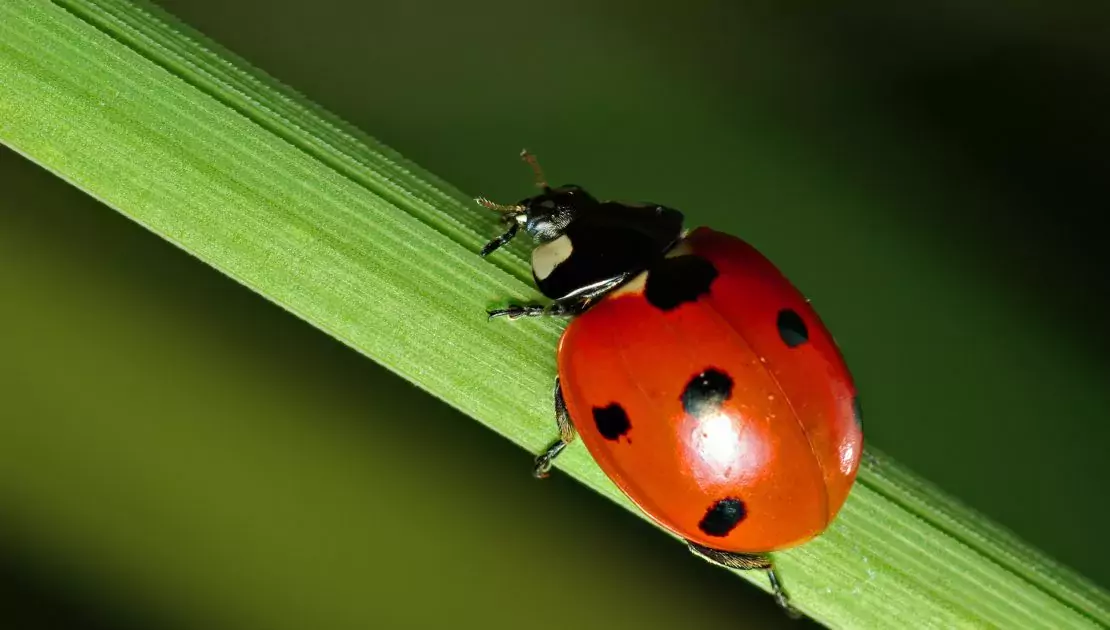
- Ladybugs, which eat small caterpillars and eggs.
- Parasitic wasps lay eggs inside caterpillars. The developing larvae consume the caterpillar from within.
- Ichneumon wasps, which parasitize cabbage worms and armyworms.
If you see white cocoons on a caterpillar’s back, do not kill it. It is already parasitized and producing beneficial wasps.
How to support beneficial insects:
Avoid broad-spectrum insecticides. Grow nectar plants such as dill, fennel, yarrow, alyssum, and calendula. Leave shelters made of branches, stones, and logs where beneficial insects can overwinter.
Avoid broad-spectrum insecticides. Grow nectar plants such as dill, fennel, yarrow, alyssum, and calendula. Leave shelters made of branches, stones, and logs where beneficial insects can overwinter.
A Weekly Organic Rose Protection Plan
Week 1:
- Hand-pick caterpillars morning and evening.
- Spray Bt thoroughly in the evening.
- Install sticky or corrugated trunk bands.
Week 2:
- Repeat Bt if rain occurred.
- Add garlic spray between biological treatments.
- Inspect and replace trunk bands.
Week 3:
- If caterpillars are numerous, alternate Bt and Beauveria every 2 to 3 days.
- Dust young shoots with wood ash.
Week 4:
- Perform a final inspection.
- If damage has stopped, switch to prevention mode.
- Apply chitosan to strengthen plant immunity.
Common Gardening Mistakes
Mistake 1:
Spraying Bt during hot daytime weather.
The bacteria die rapidly in sunlight. Spray only in the evening.
Spraying Bt during hot daytime weather.
The bacteria die rapidly in sunlight. Spray only in the evening.
Mistake 2:
Treating once and forgetting.
New caterpillars hatch every 3 to 5 days. Repeat weekly for a month.
Treating once and forgetting.
New caterpillars hatch every 3 to 5 days. Repeat weekly for a month.
Mistake 3:
Spraying only the top side of leaves.
Most caterpillars feed underneath. Spray upward to coat the undersides.
Spraying only the top side of leaves.
Most caterpillars feed underneath. Spray upward to coat the undersides.
Mistake 4:
Mixing Bt with copper fungicides.
Copper kills the bacteria before they reach the plant. Leave at least 48 hours between treatments.
Mixing Bt with copper fungicides.
Copper kills the bacteria before they reach the plant. Leave at least 48 hours between treatments.
Mistake 5:
Destroying caterpillars covered in white cocoons.
These caterpillars are already infected by beneficial parasitic wasps and no longer feeding.
Destroying caterpillars covered in white cocoons.
These caterpillars are already infected by beneficial parasitic wasps and no longer feeding.
Organic gardening requires attention and consistency, but it creates a self-regulating ecosystem where beneficial insects control pests, birds clean up leftovers, and plants grow stronger and more resilient every season. It is not an instant spray-can solution. It is a long-term system that protects your garden year after year.
If You’re Trying to Figure Out What Your Plants Are Really Telling You
If caterpillars keep coming back no matter what you try, the real issue is often timing, coverage, or missing the early signs — not a lack of sprays. That is why I wrote Why Doesn’t My Rose Grow and Bloom? – 100 Reasons and Solutions. It helps you read what your plant is actually telling you, so you stop guessing and start fixing the root cause.
The fastest way to get better at this is to keep notes. When you record what you applied, when you sprayed, and what the weather was doing, patterns emerge within a single season. I designed the Rose Garden Planner 2026 – Log Book for exactly that — so every year builds on the last instead of starting over.
And if you want fewer pest problems from the start, healthy soil with active microbes and simple organic inputs prevents more issues than any spray can solve. Revolution in the Rose Garden – Organic Rose Gardening shows how to build that foundation in a real home garden, step by step.
Rose gardening books


Step into a calmer, more confident rose season. With Ann Devis’s rose gardening books and planner, you’ll get simple organic routines, proven tips, and checklists that keep your roses thriving – from first bud to last bloom.

Frequently Asked Questions: Organic Caterpillar Control
Look for round or stretched holes in leaves with edges that look neatly cut by scissors. On cabbage, you may find green crumbs (caterpillar droppings) hidden between the leaves. On roses, watch for leaves curling into tubes (leafroller damage) or shoots turning black because a caterpillar has bored inside the stem. Fruits may develop deep tunnels filled with frass — a mix of droppings and plant debris. Caterpillars are most active at dusk and during the night, hiding on the underside of leaves or in bark cracks during the day.
Yes. Bt is a soil bacterium that is harmless to bees, ladybugs, birds, humans, and pets because their digestive systems are different from caterpillars. The toxin only activates inside the alkaline gut of caterpillars. However, it is important to understand that Bt will kill any caterpillar that eats it — not just pest species. This means it can also harm butterfly and moth larvae, including beneficial pollinators. Use it with caution and only when damage is significant.
There are four common reasons Bt fails. First, you may have sprayed during hot daytime weather — sunlight and temperatures above 30°C destroy the bacteria within hours. Second, you may have treated only once — new caterpillars hatch every 3 to 5 days, so you need to repeat applications every 5 to 7 days for at least a month. Third, you may have sprayed only the top side of leaves while most caterpillars feed underneath. Fourth, you may have mixed Bt with copper or sulfur fungicides in the same sprayer, which kills the living bacteria. Always leave at least a 48-hour gap between Bt and copper treatments.
Caterpillars do not die instantly. They typically continue feeding for 1 to 2 days after treatment, then stop eating and die within 24 to 72 hours. This is normal. Check again after 3 days — if caterpillars have become sluggish, darkened, or disappeared, the treatment is working.
Do not mix Bt with copper or sulfur products in the same sprayer, as these kill the bacteria. If you need to treat fungal diseases too, apply them on separate days with at least a 2-day gap. Bt can generally be combined with insecticidal soaps or plant-based sprays that do not contain copper or sulfur, but it is safest to apply Bt alone to ensure the bacteria remain alive on the leaf surface.
Bt is a bacterium that must be eaten by the caterpillar to work. Beauveria bassiana is a fungus that grows through the insect’s outer shell and fills the body with white fungal threads, killing the caterpillar within 3 to 7 days. It works best in humidity above 60% and temperatures between 18°C and 28°C. Metarhizium anisopliae is another beneficial fungus that is especially effective against cutworms hiding in the soil. You can alternate Bt and Beauveria — for example, Bt in the evening and Beauveria two days later in the morning — for broader protection.
Neem oil works differently from Bt. It disrupts caterpillar hormones, causing them to stop feeding, fail to molt properly, and eventually die from starvation within 3 to 7 days. It also protects new leaves that grow after treatment. Unlike Bt, which must be eaten, neem has some contact effect. However, neem is slower to show visible results than Bt. For heavy infestations, Bt is usually the faster and more reliable choice. For ongoing protection and hormone disruption, neem is excellent.
Yes, diatomaceous earth is safe for people, bees, and fish. It consists of microscopic fossilized algae skeletons whose sharp edges damage the caterpillar’s protective coating, causing dehydration and death within 1 to 2 days. Apply it as a dry dust over leaves and stems, or mix 50 grams per liter of water and spray. It only works in dry weather because rain washes it away. Vegetables can be eaten after rinsing with water.
Yes. Leafroller damage — leaves curling into tubes — can look similar to aphid damage or physiological leaf curl. However, caterpillar damage typically includes neat, scissors-like holes in leaves and blackened shoot tips where a caterpillar has bored inside the stem. If you unroll a curled leaf and find a caterpillar or frass inside, you have confirmed the culprit.


