

grey mold on roses

How to Treat Grey Mold on Roses: A Complete Guide

Grey mold on roses, caused by Botrytis cinerea, thrives in cool, damp conditions. Remove affected flowers and leaves immediately, improve air circulation, and apply an organic fungicide. Proper spacing and avoiding overhead watering are key to preventing further outbreaks and protecting your rose blooms.

Botrytis cinerea is the organism behind it, and unlike powdery mildew, which is a rose specialist, this one is a generalist that also attacks strawberries, grapes, tulips, peonies, and dozens of other plants in nearly every temperate garden on earth.

What is Grey Mold (Botrytis cinerea)?

Grey mold, caused by the fungus Botrytis cinerea, is a common plant disease that targets weakened or dead plant tissue. It affects many plants, including roses, particularly those in the Floribunda and Hybrid Tea groups. The disease spreads rapidly in environments with high humidity, especially during the spring and fall.

How Grey Mold Affects Roses

Botrytis cinerea is an opportunistic pathogen that invades plants through wounds, weakened tissues, or dead flowers. Once inside, it spreads quickly, producing a fuzzy greyish mold on infected parts of the plant, including:

  • Petals
  • Leaves
  • Stems
  • Buds

Without intervention, the fungus can cause severe damage, rotting buds, and flowers before blooming, withering leaves, and decaying stems.

Recognizing Symptoms of Grey Mold on Roses

Detecting Botrytis early is critical to controlling the spread of the disease. Here are the common symptoms to watch out for:

Early Signs

  • Yellow or brown spots on petals that quickly expand.
  • Wilted or soggy-looking flowers, especially during wet conditions.

Advanced Symptoms

  • Grey fuzzy mold visible on infected areas.
  • Rotting buds that fail to open.
  • Stem lesions and weakened branches.
  • Flower drop before blooms have fully matured.
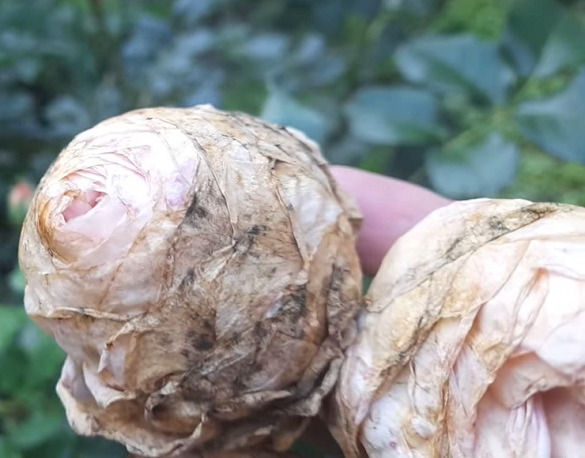
grey mold on roses, 6. How to manage bacterial diseases in roses

Conditions That Promote Grey Mold

Understanding what encourages Botrytis can help you prevent its development. The following conditions make roses more susceptible:

  • High humidity (above 85%) and poor air circulation.
  • Cool temperatures between 15-20°C (59-68°F).
  • Crowded planting leads to poor airflow.
  • Overhead watering, which keeps the foliage wet.
  • Damaged or decaying plant tissue provides entry points for the fungus.

Addressing these environmental factors can minimize the chances of Botrytis affecting your roses.

Organic Prevention: Where Most of the Fight Actually Happens

Prevention carries most of the weight here, because Botrytis can’t get going without a wound or some dying tissue to land on, and in a rose bed, we’re usually the ones supplying those wounds.
Start with the unglamorous habit of deadheading on a schedule rather than whenever you happen to notice a spent bloom. Every faded flower left hanging on the bush is basically a spore factory waiting to happen. I cut back to the first strong five-leaflet leaf and make sure the trimmings never sit on the soil underneath, because that damp little pile is exactly the microclimate this fungus loves.
Pruning matters just as much, and not only for its timing. A clean cut into wood the bush can seal over heals quickly; a ragged one left open through a cool, wet spell is close to an invitation. I try to avoid a big pruning session right before rain is forecast, though I’ll be the first to admit the weather rarely cooperates with my calendar.
Watering is one of those quiet daily habits that ends up deciding the outcome. Water at the base, and do it in the morning; never over the flowers in the evening, since wet petals overnight are close to the worst possible setup once you factor in how long that dampness lingers and at what temperature.
Airflow costs nothing and does more than people give it credit for. Give the bush room to breathe, space plants so mature growth isn’t touching its neighbor, and thin out the center each spring. Gray mold, like most fungal trouble in a rose bed, settles into still, humid pockets, so anything that keeps air moving through the plant is working in your favor.
Nitrogen is worth going easy on too. Soft, lush growth is weak growth, and Botrytis isn’t picky about which kind of weak tissue it exploits.
Then there’s calcium, which honestly surprised me when I went digging. A handful of studies on cut roses and on petunias, most of them focused on postharvest handling rather than a living garden bed, found that plants with better calcium availability grew noticeably stronger petal cell walls and gave Botrytis a harder time establishing. I haven’t come across anyone who ran that same test on roses still growing outdoors rather than cut stems in a vase, so I want to be upfront about where the evidence actually stands: solid for postharvest, thinner for the living garden. Even so, it’s a reasonable enough argument for making sure your feeding program isn’t calcium-starved, especially if you’re gardening in light, sandy soil where calcium washes out fast.

How to Treat Grey Mold on Roses

If prevention didn’t hold and you’re staring at that gray fuzz, here’s the order I actually work through.
First, cut off and bag the affected bud, bloom, or cane section, well below the visible damage, and get it off the property instead of onto the compost pile. A spray isn’t going to cure that tissue. You’re removing the spore source it’s about to become, which matters more than treating what’s already lost.
Of everything on this list, Bacillus subtilis biofungicides have the most genuinely rose-specific track record. Products built on the QST 713 strain, sold as Serenade among other names, are labeled specifically for gray mold on roses and ornamentals, not borrowed from some other crop’s approval. In one study, treating cut ‘Baccara’ roses with a Bacillus subtilis suspension gave a real, measurable improvement in Botrytis control, along with a boost to the plant’s own antioxidant defenses. I’ll be honest that most of the controlled research I could find tested cut, harvested roses rather than bushes still in the ground, which is a real gap, though the underlying mechanism- bacteria colonizing the tissue and crowding the fungus out before it can settle in works the same whether the stem is in a vase or still attached to the plant. I’ve written more about how I use this microbe more broadly in my Bacillus subtilis guide. It’s the product I reach for first, ideally before symptoms show up if a wet stretch is in the forecast, since like most biofungicides it does far more as prevention than as rescue.
 

Organic garden helpers

simple and effective
Trichoderma has real research behind it as well, just not much of it on roses specifically. Strains of Trichoderma harzianum, including one sold commercially as Trichodex, carry a long track record against Botrytis in grapes, strawberries, and tomatoes. In my own garden it’s mainly a soil drench for root health, with a monthly foliar pass thrown in as general biological coverage rather than a dedicated Botrytis treatment, and I can’t honestly tell you how much of my results trace back to that one piece versus everything else I’m doing at once.
Neem oil earns a place too, on light, early infections, working mostly by physically smothering the fungus rather than through any single active compound. Skip it above 90°F, and keep it well clear of any sulfur application by at least two weeks.
Sulfur is my usual answer for powdery mildew and rust, but it’s not the right tool here. It mainly works by stopping spores from germinating on the leaf surface before infection starts, which suits powdery mildew’s biology well. Botrytis plays a different game, exploiting wounds and dying tissue rather than colonizing healthy living cells, so that same vapor-phase action doesn’t have much to work against. I skip sulfur for gray mold and put that spray day toward sanitation and airflow instead.
Copper doesn’t earn much effort here either. The research on copper against Botrytis specifically is thin next to what exists for Bacillus subtilis or even calcium, and copper can leave visible spotting on petals, which matters more on a flowering ornamental than it does on foliage. I still keep copper in rotation for other diseases in the garden. Just not this one.

How to Prevent Grey Mold on Roses

Prevention is always better than cure, and there are several strategies you can adopt to keep grey mold at bay.

1. Ensure Proper Spacing

Plant roses with ample space between each bush. This allows air to flow freely through the plants, reducing moisture buildup that can encourage fungal growth.

 2. Regular Pruning

Regularly prune your roses to remove dead or decaying tissue. Deadheading old flowers and removing fallen petals from the ground will also help reduce the sources of infection.

3. Manage Humidity

In areas with naturally high humidity, consider adding mulch around the base of your roses to help absorb excess moisture from the soil. Additionally, ensure the rose bed is in a sunny, well-ventilated area.

4. Use Disease-Resistant Varieties

If grey mold has been a recurrent issue, consider planting disease-resistant rose varieties. Some rose species have been bred to withstand fungal infections better than others.

Where This Fits Into My Regular Rotation

I don’t run a separate spray program just for gray mold. It slots into the same calendar behind my black spot protocol, just with the emphasis shifting toward whichever disease the current weather favors. Seaweed extract and chitosan go down every two to three weeks as general immune conditioning, chitosan on its own once a month, by leaf or by root, kept separate from everything else, since for me it’s a broad resilience tool rather than a treatment aimed at any one disease.
Bacillus subtilis gets its turn roughly every two weeks through the cool, damp stretches of spring and again into autumn, which happens to be exactly when gray mold pressure spikes in my garden. Silicon is part of the regular feeding too, though it’s better documented against powdery mildew than against Botrytis specifically. There is now real published research on silicon reducing gray mold in strawberries and greenhouse crops, and at least one study measuring its effect on rose quality after harvest, but I can’t hand you a clean percentage for gray mold on garden roses the way I can for powdery mildew. So I’ll leave it there instead of rounding up to sound more certain than the evidence actually is.

Want the complete system?

This gray mold protocol is one piece of a larger approach: building living soil, priming the plant’s own defenses, and keeping disease pressure low before it ever gets started. That whole system, prevention-first and chemical-free, is what I laid out in Revolution in the Rose Garden — Organic Rose Gardening: Building Living Soil, Preventing Disease Naturally, and Growing Strong, Beautiful Roses Without Chemicals.

Rose gardening books

Step into a calmer, more confident rose season. With Ann Devis’s rose gardening books and planner, you’ll get simple organic routines, proven tips, and checklists that keep your roses thriving – from first bud to last bloom.

When to Just Accept the Loss and Move On

Some springs hand you two solid weeks of gray, damp, still weather with no real break, and a rose tucked into a shady, crowded corner is going to get hit no matter how carefully you spray. When that happens, the more useful move is often just accepting the loss on that one flush of buds, cleaning up thoroughly, and letting the next flush come in under better conditions, rather than treating every affected bloom like an emergency. I’ve done exactly that more than once, and the bush always came back fine once the weather turned.

Frequently Asked Questions

A fungus called Botrytis cinerea, which infects through wounds and damaged or dying tissue rather than healthy living cells. It needs sustained moisture, either continuous wetness of six or more hours or relative humidity above about 90 percent for a similar stretch, and it’s most active in the 70 to 77°F range, though research on rose flowers specifically found real damage even at cooler temperatures given enough hours of wetness.
No. Powdery mildew is a specialist fungus that only infects roses and shows up as a dry, white, powdery coating that thrives in dry weather with cool nights. Gray mold needs sustained moisture to infect, attacks buds and stems as much as leaves, and produces a grayish, fuzzy coating rather than a fine white dust.
I wouldn’t. Botrytis survives as tough resting structures in dead plant material and produces enormous numbers of spores from infected debris. Bag and remove it instead of adding it to a home compost pile that likely doesn’t get hot enough to kill the fungus.
The strongest evidence I found is a study on cut ‘Baccara’ roses showing real, measurable control from a Bacillus subtilis suspension, and commercial products built on the same bacterial strain are labeled specifically for gray mold on roses and ornamentals. Most of the controlled research is on cut, harvested flowers rather than bushes in the garden, which is worth knowing, but the biology behind why it works doesn’t depend on the stem being in a vase.
Neither is my first choice. Sulfur’s mode of action fits powdery mildew’s biology much better than Botrytis’s wound-and-decay strategy, and the research base for copper against gray mold specifically is thin. I keep both in rotation for other rose diseases, just not this one.
seal shut around rotting inner tissue. It usually follows a cool, damp, still stretch of weather, and it’s worth checking for the telltale gray, dusty fuzz before assuming it’s simply a bud that failed to develop for some other reason.
There’s no fixed universal schedule, because outbreaks track weather more than the calendar. I lean on sanitation and airflow as the constant baseline, and step up Bacillus subtilis applications to roughly every two weeks specifically through cool, damp, still stretches of spring and autumn, easing off once drier weather sets in.

Leave a Comment

Sign In

Register

Reset Password

Please enter your username or email address, you will receive a link to create a new password via email.

Scroll to Top